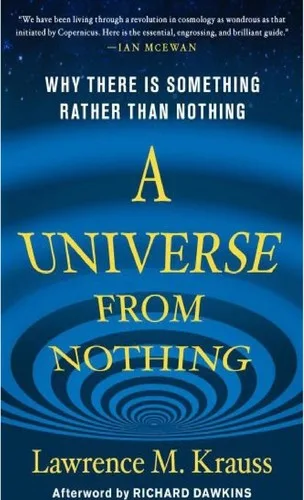
A Universe from Nothing (2010)
A Universe from Nothing is a 2010 science / cosmology book written by Lawrence Maxwell Krauss.
Lawrence Krauss takes the oldest question in metaphysics and hands it to physics instead. Something rather than nothing: he argues that modern cosmology has an answer, and that empty space is far stranger and more generative than intuition allows. Drawing on quantum fields, the accelerating expansion of the universe, and the peculiar physics of the vacuum, he builds the case that a universe can arise without a first cause. The tone runs brisk and combative, aimed squarely at readers who assume the question belongs to philosophy or religion. Clear, provocative, and unafraid of where its own reasoning leads.
Official site
http://krauss.faculty.asu.edu/books/a-universe-from-nothing/
Explore A Universe from Nothing guides
A few thoughts on A Universe from Nothing
Carl Sagan's Cosmos, and the Neil deGrasse Tyson revival, cover the same wonder on television, trading Lawrence Maxwell Krauss's argument for a sweeping visual tour of deep time and space. Christopher Nolan's Interstellar turns the physics into drama, relativity and cosmic scale rendered as something a family lives through rather than reads about.
Popular science books that tackle humanity's biggest questions
Lawrence Krauss hands the question of existence to physics, brisk and combative. These books share that same territory: Hawking's Brief Answers to the Big Questions, Dawkins's plain-language primer The Magic of Reality, Kaku's forward-looking Physics of the Future, Gould's essays in Ever Since Darwin, Reich's genetic history Who We Are and How We Got Here, and Hawking's cosmic-scaled book for younger readers, George's Cosmic Treasure Hunt.
Science documentary series that turn cosmology into television
Krauss argues physics answers the oldest question, not philosophy, and these documentary series share that same instinct for turning real science into compelling factual television. Carl Sagan's Cosmos: A Personal Voyage remains the benchmark for the form, while Once Upon a Time... Life, Vetenskapens värld and Superquark carry the same explain-the-real-world curiosity into other national traditions of science broadcasting.