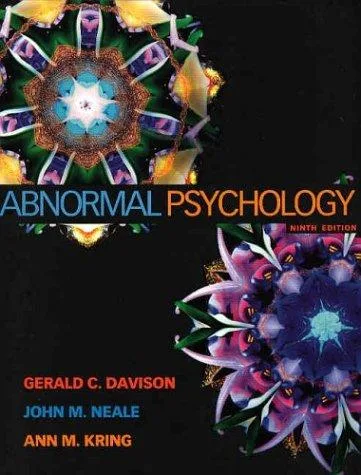
Abnormal Psychology (1974)
Abnormal Psychology is a 1974 psychopathology book written by Gerald C. Davison and John M. Neale.
A university textbook that surveys the study of psychological disorders through what its authors call an integrative approach. Rather than tracing any single cause, it treats conditions as the product of many forces at once: biological, psychological, cultural, social, familial, and even political. Chapters move through the major categories of disorder alongside the research methods and clinical reasoning used to understand them, with review tools to test comprehension along the way. Written by three field-recognized researchers, it is built for coursework, structured to carry a student from broad frameworks toward specific diagnoses.
Similar books
A few thoughts on Abnormal Psychology
A classroom text, not a bedside read. Reach for it if you want the scaffolding of the field, how disorders are defined, studied, and debated, rather than a single popular narrative about the mind. Its real strength is the integrative frame: no one factor explains a disorder, a useful corrective to tidier pop-psychology.
Textbooks to read after a first psychopathology course
Abnormal Psychology moves fast through each major category of disorder, which leaves room for a second pass on one area at a time. These go deeper: a reference-length survey of psychopathology, a personality-focused map of diagnosis, a working guide to how psychiatric drugs act on the brain, and a developmental account of how disorders take shape across a life.
Sorting solid clinical evidence from pseudoscience
The integrative approach in Abnormal Psychology rests on research methods it teaches alongside the disorders: how researchers design a trial, how tests earn their validity, how a clinician writes up a case. Carry that further with a field guide to dubious clinical claims, two general psychology surveys covering method in depth, a behavioral-treatment handbook, and a casebook that applies the reasoning to individual patients.
Shows and films set on the therapist's side of the room
Abnormal Psychology describes treatment from the outside, in chapter summaries and outcome data. These put a clinician in a room with a patient and let the hour run: a hospital psychiatrist arguing with his own staff, a school counsellor who listens more than she prescribes, a group-therapy comedy, and survivors who trained to do the work themselves. They fill in the hour the textbook compresses into a statistic.
Films that use a diagnosis as a plot device
Read the dissociative and anxiety chapters of Abnormal Psychology, then watch how screen writers handle the same material. A documentary follows a forensic psychiatrist through decades of court testimony; the rest are fiction, including a 1965 study of a young woman's withdrawal and a gothic asylum picture. Read them against the chapters and the gap is easy to spot.