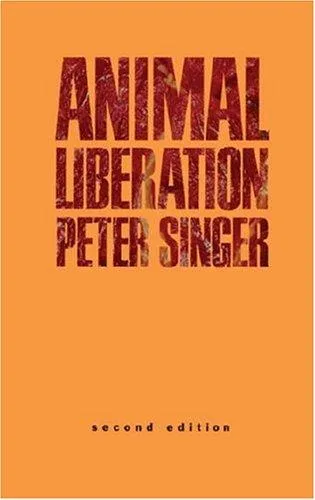
Animal liberation (1975)
Animal liberation is a 1975 animal rights book written by Peter Singer.
Peter Singer argues in plain academic prose, one step at a time, and the conclusions arrive without a raised voice.
His starting point comes from Jeremy Bentham: the capacity to suffer is what earns a being moral consideration. On that basis Singer holds that an animal's interest in avoiding pain belongs in the same reckoning as a human's, and that discounting it by species is a prejudice of the same shape as the ones we already reject. He took the word speciesism from Richard D. Ryder and gave it wide currency. He also sets the language of rights aside, for animals and for people alike, treating rights as scaffolding his argument does not need.
Alongside the philosophy, Singer describes what factory farms and research laboratories were doing to animals in 1975, then asks the reader to hold the practice against the ethics. The book became the founding philosophical statement of the animal liberation movement, and Singer returned to it decades later as Animal Liberation Now, extending the case to meat's effect on the climate and to the spread of new viruses.
The position belongs to Singer, and he states it in terms a reader can weigh or refuse. Suited to anyone who wants the argument at its source rather than at second hand, in the philosopher's own words.
Similar books
A few thoughts on Animal liberation
Singer's reporting chapters have documentary counterparts. Earthlings (2005) and Dominion (2018) put the same industries on camera, so they sit next to the book as footage to its reasoning. Take the book first if you would rather think the question through before you watch anyone film it. Milked (2021) narrows the frame to a single industry, which makes a useful test of a general claim: Singer argues at the level of principle, and one supply chain shows what that principle is about. None of the three will change what Singer wrote. They change how much of it you can picture, and they ask more of a viewer than the book asks of a reader, so pick the one whose approach you can sit with.