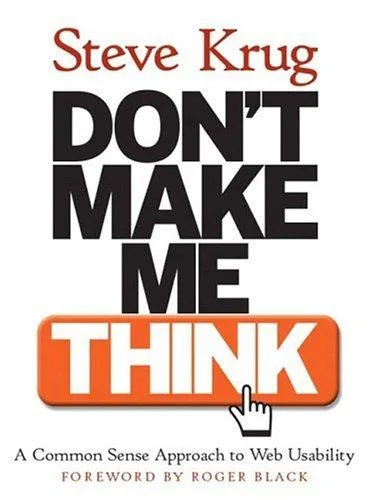
Don't Make Me Think (2000)
Don't Make Me Think is a 2000 web sites book written by Steve Krug.
Steve Krug spent years watching ordinary people fumble their way through websites, and this short primer turns those observations into a working philosophy. His central claim is simple: users satisfice. They grab the first workable option rather than the best one, they scan instead of read, and they muddle through interfaces that puzzle them. Good design respects those habits instead of fighting them. Krug walks through navigation, page hierarchy, usability testing on a budget, and the politics of surviving an executive's pet ideas. The tone stays wry and unpretentious, closer to a friendly colleague than a lecture.
Similar books
A few thoughts on Don't Make Me Think
Steve Krug's gospel of stripping away friction pairs well with Gary Hustwit's documentary Objectified, which watches industrial designers agonize over the same question in physical products. For a working designer, both reward the habit of noticing how real people actually touch a thing, then quietly removing whatever gets in their way.
Usability testing without a lab or a budget
Krug's cheapest advice in Don't Make Me Think is to grab three people, hand them a task, and watch them muddle through. These books go deeper into that method: inspection checklists, interaction research, sketching sessions, and the awkward job of carrying findings back to a room that already picked its favourite idea.
Front-end books to read after the usability book
Don't Make Me Think stops at the design decision and leaves the implementation to you. These pick up the handoff: CSS that survives real content, grid systems borrowed from print, JavaScript behaviour, blog layouts you can lift, APIs built around links, and the storage layer underneath. Krug's scanning rules only hold if the markup ships them.
Comics for people who argue about interfaces for a living
Krug gives a whole chapter to surviving the executive with a pet idea, and these strips live in that meeting. Dilbert, Dork Tower and Penny Arcade play it for laughs, xkcd for the engineering in-joke. Understanding Comics runs the serious version, taking apart how a reader crosses a panel the way Krug takes apart how you scan a page.
Screen stories set inside the internet
Krug treats the web as a calm problem you can test your way out of. These take the paranoid view: a Korean drama about rival search portals, a thriller about a smart-home installer with root access, horror assembled from forum posts. Watch them for how ordinary people behave in front of a screen, the behaviour Don't Make Me Think builds its rules from.