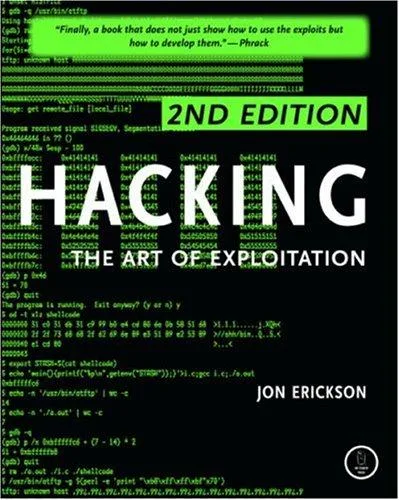
Hacking (2008)
Hacking is a 2008 computer networks book written by Jon Erickson.
Jon Erickson treats hacking as creative problem solving rather than button pushing. Instead of cataloguing ready-made exploits, the book rebuilds the foundations: C, assembly, and shell scripting seen from an attacker's angle, so you grasp why a technique works before you run it. Chapters walk through buffer overflows, network hijacking, cryptographic weaknesses, and the machine-level details most tutorials skip past. This second edition ships a bootable Linux CD holding every tool and code sample, so you can compile, break, and debug alongside the text on Gentoo without touching your own system. Written for readers who want the mechanics under the surface.
Similar books
- Networking all-in-one for dummies (2016)
- Network Warrior (2007)
- Security+ Guide to Networking Security Fundamentals (2004)
- CCENT Cisco Certified Entry Networking Technician study guide (exam 640-822) (2008)
- The Internet gigabook for dummies (2004)
- Synchronization Control for Large-Scale Network Systems (2016)
- Multimedia Technology and Enhanced Learning (2020)
A few thoughts on Hacking
The appeal here is watching a system bend in ways its builders never intended. The TV series Mr. Robot chases that same fidelity, staging its attacks with real command lines and tools. For the culture and stakes around it, Cory Doctorow's novel Little Brother follows teenagers turning these skills against surveillance, and the documentary The Great Hack traces where the data actually goes.
Books that go deeper into exploits, malware and the shell
Erickson spends Hacking rebuilding C, assembly and shell scripting from an attacker's seat before he shows you a single exploit. These books pick up where his bootable Gentoo CD leaves off: framework tooling, malware teardown, shell fluency and the algorithm background that makes a stack diagram legible. Read them with a debugger open.
Hacking games that hand you a real terminal
Hacking teaches you to read a stack frame and watch a buffer spill past its bounds. These games hand you a terminal and expect the same patience. Hacknet and Uplink run on file trees and command syntax, Exapunks makes you write assembly for a paycheck, and NITE Team 4 drills open source intelligence work.
Hacker movies from phone phreaks to firewalls
Erickson wrote Hacking against the screen version of the craft, where a montage replaces the debugger. These films built that screen version, and a few of them earned their reputation. WarGames and Sneakers respect phone phreak tradecraft, Hackers turned the scene into fashion, and Live Free or Die Hard treats a national grid as one login.
Series and comics built around a hacker lead
Hacking keeps its attention on the person at the keyboard, the mindset that treats a locked system as a puzzle worth picking apart. These series and comics build characters on that mindset. Mr. Robot gets the tooling right down to the command flags, Bloody Monday runs on teenage prodigy pressure, and Ghost in the Shell pushes the question toward identity.