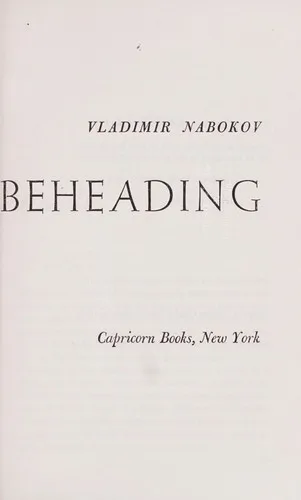
Priglashenie na kaznʹ (1938)
Priglashenie na kaznʹ is a 1938 surreal book written by Vladimir Nabokov and Dmitri Nabokov.
Cincinnatus C. sits in a fortress cell, condemned to death for a crime the authorities call gnostical turpitude: the offense of being opaque, unknowable, unlike everyone around him. Vladimir Nabokov turns his imprisonment into a shifting, dreamlike ordeal where jailers, visitors and even the walls feel staged, and no one will tell him the hour of his execution. First serialized in Russian in the 1930s and later translated with his son Dmitri, the novel reads as a mordant fable about individuality under a regime that cannot bear it, playful and quietly terrifying in equal measure.
A few thoughts on Priglashenie na kaznʹ
Readers drawn to this absurd, oppressive dream should try Kafka's The Trial, its clearest cousin in bureaucratic dread, and Orwell's Nineteen Eighty-Four for the crushed individual under total power. Camus's The Stranger shares the condemned-man clarity and its cool, unsettling detachment.
Trials where the charge makes no sense
The court sentences Cincinnatus C. for gnostical turpitude, a charge that amounts to being unreadable to his neighbours. Priglashenie na kazn' plays its legal machinery as farce and keeps the date of the sentence secret from the prisoner. These share that footing: the verdict arrives first, and the reasoning trails behind it or never comes at all.
Nabokov's Russian novels, and the shelf they came from
Nabokov wrote Priglashenie na kazn' in Russian during his Berlin exile, years before the English novels made his name. The rest of that output sits here: Dar, Mashenka, Sogljadataj, alongside the older Russian prose he read and argued with. Same sentence-level play, same distrust of anyone who claims to know a person from the outside.
Stories where the world feels staged and the set keeps slipping
The jailers, the visitors and the fortress itself behave like props in Priglashenie na kazn', and Nabokov lets the seams show on purpose. These carry the same instability: a narrator or a camera you cannot trust, rooms that rearrange themselves, one plain event that four people describe four different ways.
Short fables built on one strange rule
Gnostical turpitude works like an anthology premise: one impossible rule, applied to an ordinary man, carried through to the end without a wink. Priglashenie na kazn' holds that level, deadpan voice even at its most absurd. These shorter fables work the same way, each built around a single rule nobody inside the story finds odd.