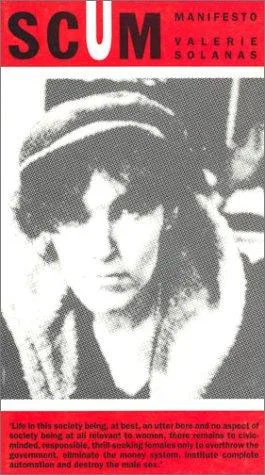
SCUM Manifesto (1967)
SCUM Manifesto is a 1967 feminism book written by Valerie Solanas.
Valerie Solanas self-published this incendiary tract in 1967, a year before she shot Andy Warhol. The pamphlet argues, in cold and furious prose, that men have degraded human life and that women should seize control, automate labor, and abolish money. Readers still argue over how much is a literal call to arms and how much is savage satire. Solanas wrote from poverty and the margins, and the writing carries that rage. Some passages read as startlingly prescient about technology and gender; others are built to outrage. It remains a lightning rod in the history of radical feminism.
Similar books
A few thoughts on SCUM Manifesto
Mary Harron's film I Shot Andy Warhol dramatizes Valerie Solanas and her collision with the Factory, Lili Taylor playing her with wounded ferocity. The Velvet Underground's debut album conjures the same downtown New York that surrounded and shaped her, all glamour and menace. It is a record of the exact scene she moved through and then turned against.
Valerie Solanas and the Warhol-era New York she wrote from
Solanas sold SCUM Manifesto by hand on New York streets in 1967, a mimeographed pamphlet from the ragged edge of Warhol's Factory scene. These circle the same years and the same person: a biography and a novel that reconstruct her life, a film about the shooting, the record that defined downtown art rock, and the magazine where the next generation of underground cartoonists landed.
Feminist books that pick a fight with the reader
SCUM Manifesto works by overstatement, and readers still split over how much Solanas meant as satire. These books share its appetite for argument rather than explanation: on sex and power, on pornography and law, on who feminism has served and who it left out. One of them takes up Solanas directly. Read the row for the range of positions in it.
Fiction about tearing the whole system down
Solanas laid out a program: automate the work, abolish money, end male control. These run a comparable fantasy through story instead of argument. An underground army of women broadcasts from 1980s New York, a masked revolutionary works on London, a managed utopia sells its citizens contentment, and a state tries to cure violence by rebuilding one young man's mind.
Stories about women refusing the role their decade handed them
Solanas wrote from poverty, sex work and the fringe of the art world, and the rage in SCUM Manifesto comes from being offered no place in any of them. These follow other women pushing at the limits of their era: a 1930s novel about a prison reformer, a 1970s magazine startup, a memoir about a teacher who crossed a line, and a comic strip that built a lesbian social world.