SimCity (1989)
SimCity is a 1989 simulator video game made by Maxis.
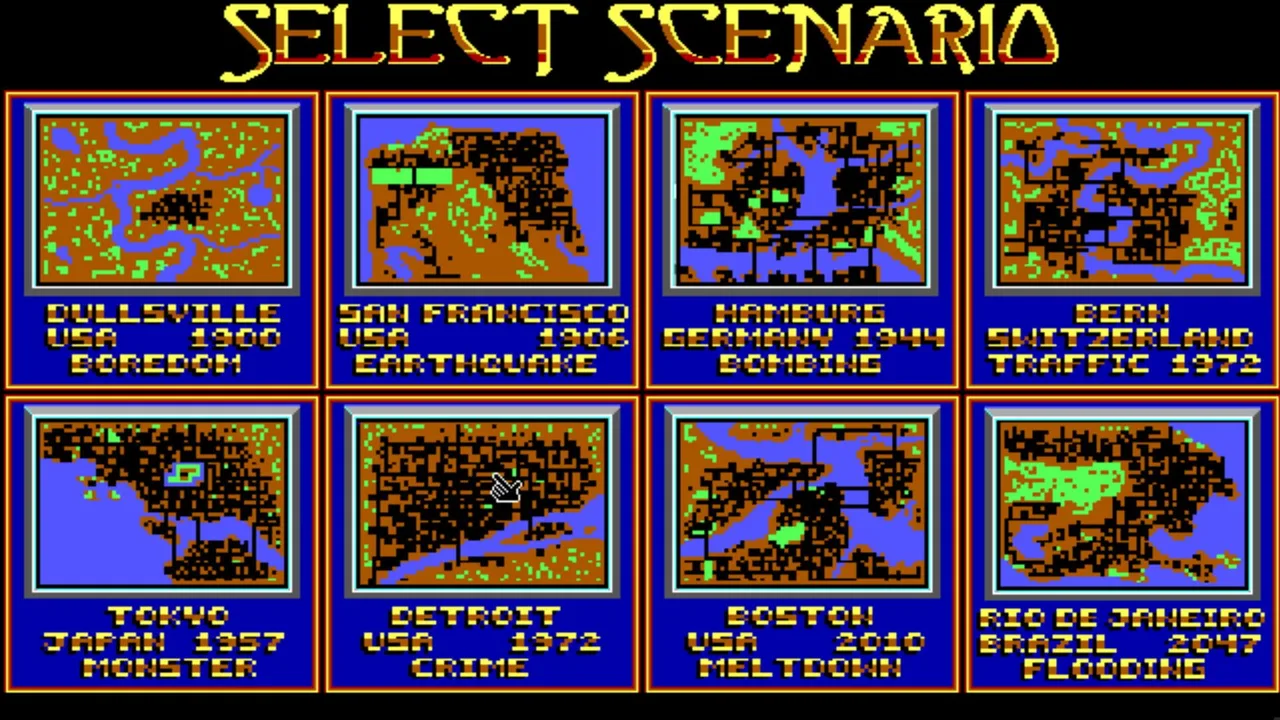
Designed by Will Wright and released in 1989, SimCity invented the city-builder genre out of almost nothing. You zone residential, commercial, and industrial land, lay roads, fund police and fire departments, and watch a population either flourish or flee depending on your decisions. Disasters strike at random or on command. There are no citizens with names or faces, only demand curves and tax rates, yet the city somehow feels alive. It is a simulation of consequence: every budget cut eventually shows up on your streets.
Similar games
SimCity in our writing
- Companion guide: Maxis: SimCity, The Sims and Will Wright's Software Toys
A few thoughts on SimCity
As the game that launched a genre and a studio, SimCity still holds up as a lean, legible design. It strips city-building to its core logic and never loses sight of it. For anyone tracing the lineage of simulation games, it is an essential starting point.
City games you can play with no way to lose
SimCity has no win screen and no game over. You zone land, fund the fire department, and stop when you feel like it. The others ask the same thing of you: lay something down, let it grow, come back later. Pocket City and SimCity Societies keep the zoning, and the Animal Crossing and Minecraft books cover the same itch in other worlds.
Books and films about who decides what a city becomes
Will Wright built SimCity on Jay Forrester's system models, and Urban Dynamics is that source text. Read it next to Jane Jacobs on why cities generate work, Lewis Mumford on the long arc from village to metropolis, and Francesco Rosi's film about developers and building permits. The game turns tax rates into streets; these turn the same argument into prose and cinema.
Stories about the people who build the software you play
SimCity started as a level editor for a helicopter shooter, and Will Wright kept the map tool instead of the game. These cover that side of the screen: Jimmy Maher on the Amiga's hardware, Jesper Juul on what a rule set does to a player, the Tetris movie on a licensing fight, and Mythic Quest on studio life.
The later SimCity games, and the music that came with them
The 1989 original gives you a flat grid, three zone types, and a budget screen. Each sequel adds layers on top: terrain and underground pipes in 2000, business deals and a soundtrack in 3000, regional simulation in 4. Start here to see how thin the first ruleset was, then play forward and hear the music grow with it.