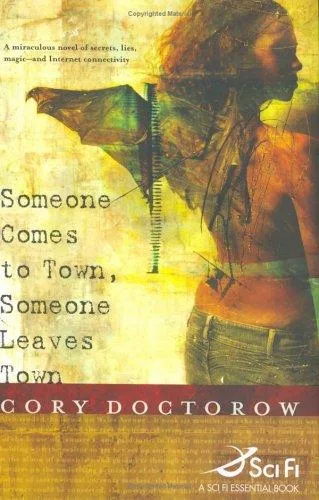
Someone Comes to Town, Someone Leaves Town (2005)
Someone Comes to Town, Someone Leaves Town is a 2005 internet book written by Cory Doctorow.
Alan sands the floors of a rambling house in a bohemian Toronto neighbourhood, shelves his secondhand books, and works hard at passing for a man with an ordinary past. His father is a mountain. His mother is a washing machine. Among his brothers is a set of Russian nesting dolls, and two of them turn up at his door close to starving.
Cory Doctorow's third novel keeps both halves of that sentence at the same volume. The city around Alan stays exact: students and layabouts in the house next door, cheap furniture, a young woman who admits under stress that she has wings, and that they grow back after every attempt to cut them off. Running beside the family folklore is a concrete piece of activism, a plan to blanket Toronto in free wireless internet, pushed by a technopunk who builds working hardware out of parts pulled from the city's dumpsters. Doctorow gives the network politics the same attention as the fairy tale.
The prose stays plain and fast. Doctorow never stops to systematise the magic into rules, and he treats Alan's impossible childhood the way you treat any family you cannot explain to strangers. Published in May 2005 and posted the same day as a free download under a Creative Commons licence, in formats down to plain ASCII, the book makes its copyright argument by existing.
Similar books
Explore Someone Comes to Town, Someone Leaves Town guides
A few thoughts on Someone Comes to Town, Someone Leaves Town
Mr. Robot is the closest match on television: a hacker with a shaky grip on his own family history, a plan to rewire who owns the infrastructure, and a narrator you cannot take at face value. Pantheon carries the same optimism about networks and the same grief about parents, and it commits to the technical detail rather than waving at it. On the comics side, Homestuck shares the internet-native sprawl and the habit of treating impossible objects as household furniture, and like Doctorow's novel it went out free to anyone with a browser. The Electric State swaps the comedy for melancholy, dead technology sitting in ordinary landscapes, which is close to how Alan's Toronto carries its strangeness.