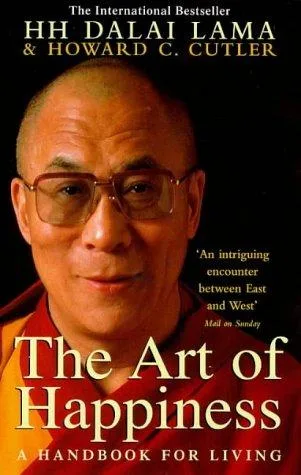
The art of happiness (1998)
The art of happiness is a 1998 doctrines book written by His Holiness Tenzin Gyatso the XIV Dalai Lama and Howard C. Cutler.
A psychiatrist sits down with the fourteenth Dalai Lama and asks the practical questions: what makes a life content, how to handle anger, why suffering need not be the last word. Howard Cutler shapes the answers into a Western self-help frame, quoting the Dalai Lama at length and adding his own clinical notes between the conversations. The result blends Tibetan Buddhist thought with everyday psychology, aimed at readers who want serenity without a monastery. Calm and plainspoken, more concerned with daily habit than doctrine, it reads as a long guided talk about training the mind toward happiness.
Similar books
Explore The art of happiness guides
A few thoughts on The art of happiness
Kundun, Martin Scorsese's film about the young Dalai Lama, gives the man a face and a history the book keeps offstage. Seven Years in Tibet covers the same court from an outsider's view. For the reflective mood, put on Philip Glass, whose Kundun score turns Buddhist patience into sound.
The Dalai Lama in print and on film
Cutler's book works by keeping the Dalai Lama talking, and these carry the same voice further. Ethics for the New Millennium argues for a morality that needs no religion, The Universe in a Single Atom takes on physics and neuroscience, Destructive Emotions puts him in a room with research psychologists. Kundun and Seven Years in Tibet show the Lhasa childhood behind the calm.
Buddhism explained without the jargon
The Art of Happiness assumes you know nothing about Buddhism and never asks you to convert. These start from the same place: Thich Nhat Hanh on breath and peace, Pema Chodron on sitting with uncertainty, two beginner guides that skip the Sanskrit, a plain life of the Buddha. Little Buddha tells the Siddhartha story for viewers who came in cold.
Films about people going looking for happiness
Cutler frames happiness as a skill you train, and these characters test the claim in their own lives. Hector leaves his psychiatry practice to ask strangers about it, Larry Darrell walks away from money after the war, a ninety-year-old in a desert town reaches his own answer. Alan Watts argues the case on paper, and one retreat sells the same promise at a price.
Comics that take belief seriously
The Art of Happiness cares about daily habit more than doctrine, which is the ground these artists draw on. Tezuka gives the Buddha eight volumes as a man with doubts, Stargazing Dog stays with one owner and his dog through a bad year, Binky Brown maps a Catholic boyhood of guilt. Faith here sits in ordinary rooms.