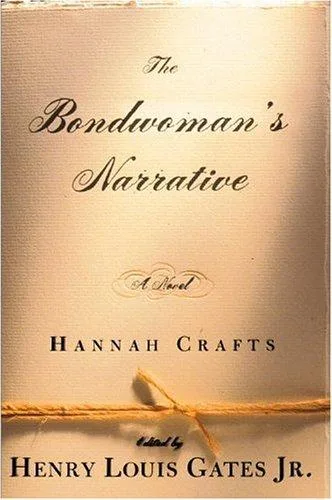
The bondwoman's narrative (2002)
The bondwoman's narrative is a 2002 american manuscripts book written by Hannah Crafts.
An enslaved woman in North Carolina wrote a novel about escaping, and the manuscript then went quiet for well over a century.
Hannah Crafts is the name on the title page. Scholars date the writing to somewhere between 1853 and 1861, and the manuscript was not authenticated and properly published until 2002. The plot turns on an escape from slavery in North Carolina, told by a narrator who stands inside the system she describes rather than looking back at it from a safe distance. The book arrives as a novel and as recovered evidence at once.
Its standing in literary history rests on those dates. Scholars place The Bondwoman's Narrative among the first novels by an African-American woman, alongside Harriet Wilson's Our Nig, published in 1859. Harriet Jacobs brought out Incidents in the Life of a Slave Girl, an autobiography from the same years, in 1861. Crafts wrote in that same window and reached print roughly a hundred and forty years later.
Come for the voice, and for the fact of the manuscript's survival. A woman who had been enslaved sat down to write fiction, the pages stayed unread through several lifetimes, and readers finally met them in 2002.
Similar books
Explore The bondwoman's narrative guides
A few thoughts on The bondwoman's narrative
Kindred adapts Octavia Butler's novel about a Black woman pulled back into a Maryland plantation, and it shares Crafts' attention to the household, where the control is domestic and constant. The Book of Negroes runs on the same first-person shape: one enslaved woman narrating her own life, the mode Crafts works in. Harriet puts the escape itself at the center, worth your time if the flight north is what draws you here. Roots sets a wide frame around that single voice, tracing one family across generations of bondage. Passing jumps forward to the Harlem Renaissance and adapts Nella Larsen's 1929 novel, another book by a Black woman writer that later scholars pulled back into the canon.