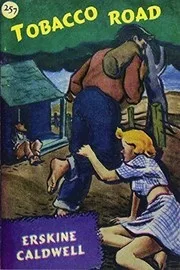
Tobacco Road (1932)
Tobacco Road is a 1932 erskine caldwell book written by Erskine Caldwell.
Jeeter Lester has not raised a crop in years. He still talks about planting, about the seed and guano he will buy once somebody extends him credit again, and the talk is most of what the farm has left.
Erskine Caldwell set his 1932 novel on a worn sand road in Georgia, where Jeeter, his wife Ada and their children live in a sagging house on land the family used to own and now sharecrops. The Depression has flattened the neighbors who once carried them, so the Lesters have only each other, and Caldwell treats that as no safety net at all.
Take it as Southern Gothic rather than documentary. Caldwell writes real hunger and real dirt, then pushes the Lesters into black comedy, and the two registers grind against each other on nearly every page. The mix caused the trouble. Readers who came for social realism about sharecropping met sensationalism instead, libraries banned the book, and people burned copies in the year it appeared. Jack Kirkland's stage version opened on Broadway in 1933 and ran for eight years. John Ford filmed it in 1941 with the laughs kept and much of the darkness cut.
The novel keeps the darkness, which is the reason to read it rather than watch it. Caldwell will not make the Lesters easy to like or easy to pity, and his argument holds steady under the farce: poverty this deep ennobles nobody.
A few thoughts on Tobacco Road
The obvious companion is Tobacco Road, John Ford's version, worth seeing mainly as a record of what a 1941 studio removed. The comedy survives intact; the degradation does not. God's Little Acre adapts Caldwell's other Georgia novel and keeps more of his blend of appetite and desperation. For the opposite argument about the same decade and the same evicted tenant farmers, The Grapes of Wrath insists on dignity exactly where Caldwell withholds it, and the two films together contain the whole 1930s quarrel over the rural poor. Our Daily Bread and Places in the Heart work the same soil with plain sympathy. Then read Li'l Abner, the hillbilly strip that started syndication in 1934, to see what mass-market comedy was doing with these people while Caldwell was being pulled off shelves.