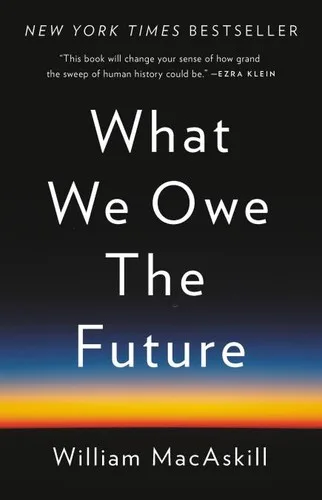
What We Owe the Future (2022)
What We Owe the Future is a 2022 altruism book written by William MacAskill.
Future generations cannot vote, protest, or argue their case, yet the choices made today will shape the lives of everyone who comes after. Oxford philosopher William MacAskill builds his 2022 book around a straightforward claim: the people of the far future count morally, there could be an enormous number of them, and our actions can make their lives better or worse. Drawing on effective altruism, he treats influencing the long-term future as one of the central moral priorities of our era, and asks how ordinary planning might reasonably stretch across dozens or even hundreds of generations rather than a single lifetime.
Official site
A few thoughts on What We Owe the Future
Readers drawn to big-picture moral reasoning should try Toby Ord's The Precipice, which maps the existential risks to humanity's survival, or Peter Singer's writing on ethics and altruism. For a sweeping view of where our species has been and where it might go, Yuval Noah Harari's Sapiens pairs naturally with William MacAskill's long-lens thinking about the generations still to come.
Moral philosophy books written for non-philosophers
MacAskill wrote What We Owe the Future for readers with no philosophy training, building the longtermism case from plain examples instead of formal proofs. These books take the same route into moral questions: a stated position, everyday language, an author willing to defend it. Several reach conclusions he would contest, which is most of the reason to read them alongside his.
Stories that zoom out to geological time
MacAskill asks readers to picture the whole span of humanity ahead, dozens or hundreds of generations, and argues that choices made now reach them. These titles run the same camera move: one patch of ground across millennia, a species across deep time, a traveler far enough forward that our present reads as archaeology. Scale is the subject in each.
Science fiction that takes civilization collapse seriously
Longtermism, as MacAskill frames it, treats extinction and civilization collapse as the outcomes most worth preventing. These films, novels and comics dramatize the specific routes there: resource exhaustion, a planet that stops supporting people, technology outrunning its makers. None of them argue the philosophy, and several predate it, but they supply the concrete scenarios What We Owe the Future keeps at arm's length.
Dystopias that let a state decide whose life counts
MacAskill's claim in What We Owe the Future is that people who cannot vote or protest still count morally. These stories invert it: societies that have settled on the opposite answer and built an office to process the paperwork. The book argues the principle at the level of policy, while Plan 75 and The Assessment put a clerk at a desk applying its reverse.