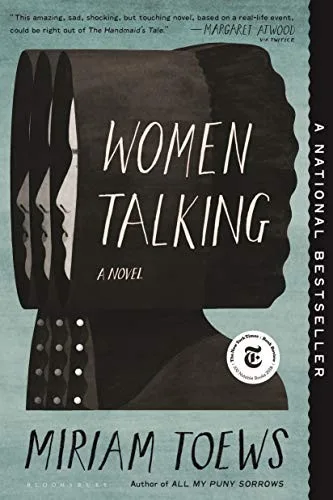
Women Talking (2018)
Women Talking is a 2018 mennonites, fiction book written by Miriam Toews.
In a remote Mennonite colony, eight women climb to a hayloft to do something the colony has never allowed them: decide for themselves. Over two years, they and more than a hundred others were drugged and assaulted in their sleep by men from their own community, and now, with those men away for two days to post bail, the women have a narrow window to act. Illiterate and cut off from the world outside, they debate whether to stay, to fight, or to leave everything they know. Miriam Toews shapes their argument, drawn from real events, into a fierce and unexpectedly funny meeting of minds.
A few thoughts on Women Talking
This story of women reasoning their way toward freedom pairs with Margaret Atwood's The Handmaid's Tale, another reckoning with control over women's bodies. Tara Westover's memoir Educated shares the pull between a closed religious world and the life beyond it, and the film Spotlight matches the moral weight of an institution protecting its own.
Closed religious communities written from the inside
Miriam Toews writes the Mennonite colony from inside its own logic: the women argue in the hayloft using the same scripture that trapped them. These titles do that for other sealed communities, a cult, a Catholic laundry, a Mennonite crime family, a mission on a reservation, and let the members explain the rules instead of an outsider.
Books and films where the whole story is one conversation
The novel is the minutes of a meeting. Eight women argue in a hayloft, August writes it down, and the argument is the whole book. Reach for these when talk carries everything: a therapist's sessions overheard through a wall, a group telling stories to wait out a plague, rooms of people circling one question they cannot drop.
Real events turned into fiction that skips the lurid detail
Toews built the colony from assaults that happened in a Bolivian Mennonite community, and she keeps the violence in the past tense, offstage, where the women can reason about it. Sarah Polley's 2022 film holds the same line. These take real histories and stay with the aftermath rather than reconstructing the harm for effect.