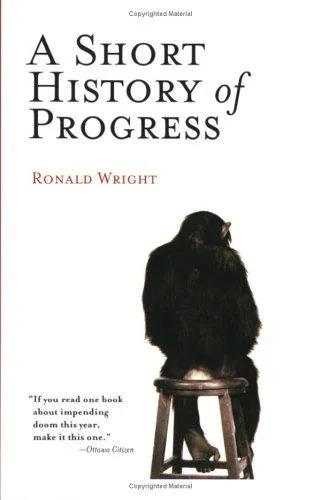
A short history of progress (2004)
A short history of progress is a 2004 history book written by Ronald Wright.
A Stone Age hunter who worked out how to bring down two mammoths instead of one had improved his lot. A hunter who worked out how to stampede a whole herd over a cliff had wrecked his own food supply. Ronald Wright calls that second move a progress trap, and he spends five lectures on how often people have walked into one.
Wright gave these talks as the 2004 Massey Lectures, five speeches delivered in five Canadian cities and broadcast on the CBC Radio program Ideas, with House of Anansi Press publishing the book version the same year. His subject is societal collapse, read from what people left behind. Wright treats the ruins standing in deserts and jungles as headstones for civilisations that their own success undid, and he argues that the load the twentieth century placed on the planet follows a pattern as old as civilisation itself. By his account the modern predicament repeats something very old.
The lecture form shapes the reading. Wright has five sittings to make his case, so he moves at speed and puts every piece of archaeology to work for the argument, leaving out the apparatus a full scholarly history would carry. Canadian readers kept the book on bestseller lists for more than a year; it won the Canadian Book Association's Libris Award for Non-Fiction Book of the Year and took a nomination for British Columbia's National Award for Canadian Non-Fiction. Later printings added illustrations.
Similar books
Explore A short history of progress guides
A few thoughts on A short history of progress
Breakpoint: A Counter History of Progress carries the same counter-history into documentary form, and it is the closest screen companion to Wright's case about growth that outruns its base. Home works at planetary scale, a documentary shot largely from the air that shows what farming, mining and building have done to the surface of the earth, so the burden Wright describes in prose sits in front of you as landscape. For the deep-time half of his frame, Life on Our Planet traces how dominant groups of life rose and vanished long before people arrived, which gives the rise-and-fall cycle Wright finds in cities and empires a much older rehearsal. Take any of the three after the book and his image of the herd going over the cliff keeps coming back.