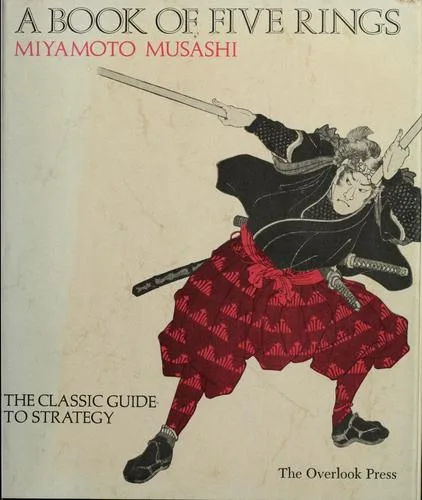
Gorin no sho (1982)
Gorin no sho is a 1982 biography book written by Miyamoto Musashi and William Scott Wilson.
Miyamoto Musashi wrote this between 1643 and 1645, near the end of a life spent in duels he reportedly never lost. He built it first as a manual for the swordsman, then let it widen into something larger: how to read an opponent, hold your ground, and act without hesitation. Five volumes borrow their names from Buddhist elements, Earth, Water, Fire, Wind, and Sky, each a lens on timing, distance, and the mind under pressure. The prose stays terse and unsentimental. Business readers later adopted it for the same reason fencers did, because it treats conflict as a discipline you can actually learn.
Similar books
Explore Gorin no sho guides
Gorin no sho in our writing
- Companion guide: Martial Arts
- Companion guide: Samurai & Feudal Japan
A few thoughts on Gorin no sho
Tezuka Osamu's Buddha comic runs the same spiritual current under Miyamoto Musashi's five elements through the life of Siddhartha. For strategy as spectacle, the manga Kingdom dramatizes the warring-states maneuvering Musashi wrote in the abstract, and Total War: Rome II lets you command it directly. Metal Gear Solid V turns questions about war, discipline, and the soldier's mind into a playable meditation.
War treated as a craft you can study and drill
Musashi wrote Gorin no sho as a working manual: read the opponent, control distance, act without hesitation. These picks share that appetite for tactics as a learnable skill, from the campaign maps of Total War: Rome II and the battlefield systems of Metal Gear Solid V to the Warring States command struggles of Kingdom and The Emperor and the Assassin, where victory turns on timing rather than brute force.
Samurai duty and self-mastery in old Japan
Gorin no sho comes out of a lifetime of duels and the code that framed them. These follow the same world of Edo and feudal Japan, where discipline and loyalty carry a price: the ronin's patient vengeance in Chushingura, the shadow killings of Tenchu, the working artists of Miss Hokusai, and Tezuka's long meditation on renunciation in Buddha.
Artists who gave a whole life to perfecting one craft
Musashi ends Gorin no sho by widening from swordsmanship to any pursuit done with total attention, which is why painters and duelists have read it alike. These portraits follow that same single-minded devotion: the piano obsession of Shine, the scores behind Louis van Beethoven and Music by John Williams, and Orson Welles reshaping his art in Magician.