Caesar III (1998)
Caesar III is a 1998 simulator video game made by Impressions Games and Sierra Entertainment.
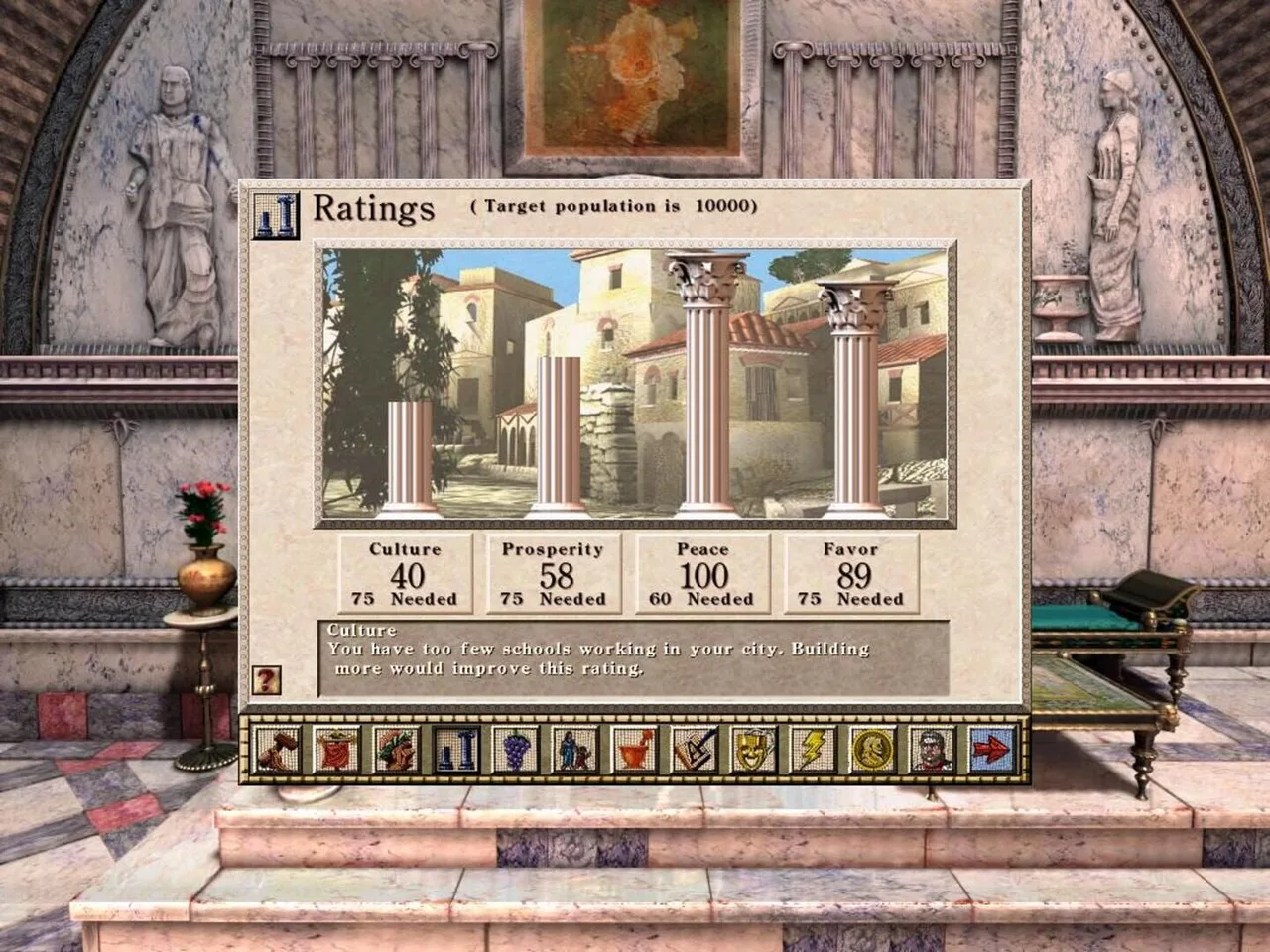
Caesar III is part of Sierra's City Building Series and was released in October 1998. Cities in Caesar III try to accurately reflect the life of Roman citizens: the lowest plebians live in tents and shacks, while the richest patricians live in villas. Staple foods include wheat, fruits, vegetables, and pork, and wine is required for some festivals and houses. Citizens wander the streets in their various garbs and can tell the player their name and how they feel about the city. The city is viewed in a two-dimensional isometric view with a fixed magnification level and can be rotated ninety degrees.
Access to services such as market goods, entertainment, hygiene, education, and taxation are represented by "walkers," people sent out from their buildings to patrol the streets. Any house that a walker passes is considered to have access to the services of the walker's building. All movements of goods and coverage of walkers are accurately reflected by citizens walking the streets: a player can watch a farm's crop progress, and when it's ready, a worker will push a full cart from the farm to a nearby warehouse or granary; then return with an empty cart. Background music is played, which varies according to the situation (gentle themes to begin with, war drums during times of conflict and triumphal music when the player nears the objective). Crowd noises supplement musical themes, the sounds of manufacturing and the clash of weapons at appropriate times.
There are two ways to play the game: Mission Mode, which is equivalent to the typical "campaign" modes of other strategy games, and City Construction Mode, in which the player plays one scenario from scratch.
Quick answers
What is Caesar III about?
Caesar III is part of Sierra's City Building Series and was released in October 1998. Cities in Caesar III try to accurately reflect the life of Roman citizens: the lowest plebians live in tents and shacks, while the richest patricians live in villas. Staple foods include wheat, fruits, vegetables, and pork, and wine is required for some festivals and houses. Citizens wander the streets in their various garbs and can tell the player their name and how they feel about the city. The city is viewed in a two-dimensional isometric view with a fixed magnification level and can be rotated ninety degrees. Access to services such as market goods, entertainment, hygiene, education, and taxation are represented by "walkers," people sent out from their buildings to patrol the streets. Any house that a walker passes is considered to have access to the services of the walker's building. All movements of goods and coverage of walkers are accurately reflected by citizens walking the streets: a player can watch a farm's crop progress, and when it's ready, a worker will push a full cart from the farm to a nearby warehouse or granary; then return with an empty cart. Background music is played, which varies according to the situation (gentle themes to begin with, war drums during times of conflict and triumphal music when the player nears the objective). Crowd noises supplement musical themes, the sounds of manufacturing and the clash of weapons at appropriate times. There are two ways to play the game: Mission Mode, which is equivalent to the typical "campaign" modes of other strategy games, and City Construction Mode, in which the player plays one scenario from scratch.
When was Caesar III released?
Caesar III was released on 15 September 1998.
Who made Caesar III?
Caesar III was made by Impressions Games and Sierra Entertainment.
Similar games
Explore Caesar III guides
Caesar III in our writing
- Companion guide: Gladiators & Ancient Rome
