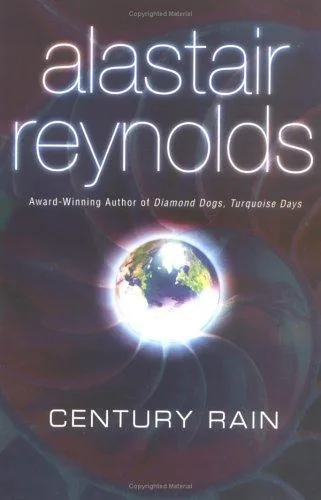
Century rain (2004)
Century rain is a 2004 fiction book written by Alastair Reynolds.
Three hundred years from now, Earth is a ruin. A technological disaster called the Nanocaust has scoured the surface, and archaeologist Verity Auger sifts what remains. Then a discovery reroutes her life: at the far end of a wormhole sits a version of mid-twentieth-century Earth, preserved whole like a fly in amber. Somewhere on that alternate world is a device that could destroy both planets on either side of the passage. Verity has to find it, and the man who means to use it, before either future runs out. Alastair Reynolds folds hard science fiction into a period detective story, moving between shattered future and quiet postwar streets.
Similar books
Explore Century rain guides
A few thoughts on Century rain
Fans of the Paris-set thread should try the film Dark City, which shares the uncanny, engineered city with a hidden purpose. The game BioShock offers the same clash of retro surfaces and lethal advanced tech. Alastair Reynolds writes big-canvas space opera, so China Mieville's Perdido Street Station suits readers who like worlds this dense and strange.
Stories about a whole vanished era preserved somewhere it should not exist
Century Rain sends its heroine through a wormhole into a perfectly preserved mid-century Earth, tucked inside a ruined future. BioShock's Rapture keeps its own decade frozen under the sea, La Brea drops modern people into a lost prehistoric world, Dark City reshapes a whole hidden metropolis every night, and At the Mountains of Madness hides an ancient civilization nobody thought to look for.
Hard science fiction that reads like a detective story
Verity Auger investigates Century Rain's frozen alternate Earth with a detective's patience, moving between clues the way Alastair Reynolds' own Revelation Space and House of Suns move between star systems chasing an old mystery. Hyperion frames its far-future war as a set of nested confessions, Rendezvous with Rama turns first contact into a pure exploration puzzle, and The Three-Body Problem lets an alien threat unfold like a slow-burn investigation.
Novels about the long, slow rebuild after Earth breaks
Century Rain opens on an Earth left in ruins by a technological catastrophe called the Nanocaust, the same long shadow that hangs over Seveneves after its own planet-scale disaster and A Canticle for Leibowitz's monks rebuilding civilization one scrap of knowledge at a time. Mara and Dann follows a harder trek across a broken continent, and Children of Time watches a new Earth-like world rise from an old species' ashes.
Time travel and parallel-world stories built around a hidden gateway
Century Rain's wormhole is a fixed, hidden gateway between two versions of Earth, the same kind of secret door that powers Sliders' hop between parallel worlds and The Rise and Fall of D.O.D.O.'s tangle of altered timelines. Synchronicity loops its inventor back through his own doorway in time, and Doctor Who: Alien Bodies trades on a relic that can unravel history from either side.