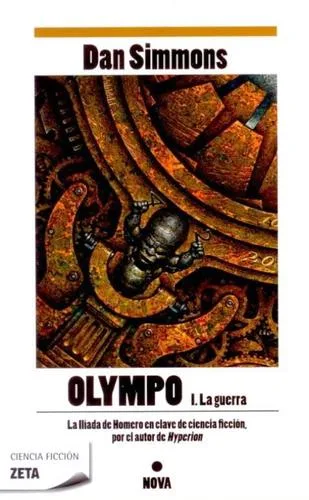
Olympos (2005)
Olympos is a 2005 greek mythology book written by Dan Simmons.
The Trojan War has gone off script. On a terraformed Mars, post-humans who style themselves Zeus, Hera, and Apollo restaged Homer's epic for their own amusement, until resurrected scholar Thomas Hockenberry stirred the plot and Achilles joined Hector in open war against the gods themselves. Simmons's conclusion to Ilium runs three boards at once: the siege turned god-hunt, the sentient machines called moravecs debating Shakespeare and Proust on their way in from the outer moons, and Earth's last pampered humans discovering their idyll carries a bill. Big, learned, and gleefully overstuffed, in the classic Simmons manner.
Similar books
Explore Olympos guides
Olympos in our writing
- Companion guide: Hyperion Cantos: The Complete Guide to Dan Simmons' Far-Future Epic
A few thoughts on Olympos
Hades treats the Greek pantheon with the same irreverent affection: a game about fighting your way through gods who bicker like family. Troy keeps the Achilles and Hector axis at human scale, with the gods stripped out. Between them they cover both halves of Dan Simmons's project, the myth and the mortals who break it.
Gods you can actually fight, and sometimes beat
By Olympos, Achilles has turned his sword on the gods who restaged his war for their own amusement, and the pantheon starts looking a lot more mortal. Hades and God of War both let you fight gods directly instead of just fearing them, Troy shows the human-scale war underneath all the machinery, and Saint Seiya puts young warriors in direct, dangerous service to a goddess.
Machines with more culture than the humans they're investigating
Olympos sends its moravecs in from the outer moons discussing Shakespeare and Proust on the way to a Mars the humans no longer understand. Ghost in the Shell and Appleseed both build societies around synthetic beings who think as carefully about art and ethics as anyone born human. Portal and Portal 2 give that same idea a sharper, funnier edge with an AI whose personality outlasts every human it meets.
Immortal powers staging human conflict for their own reasons
The Olympian AIs in this saga started the Trojan War as a game and are still running it, beyond their control. Mortal Kombat and Mortal Kombat II both run on elder gods forcing fighters into a tournament that serves an agenda beyond them. Phoenix follows one immortal power shaping human history across centuries, and Sailor Moon's teenagers turn out to be royalty caught in a war older than they are.