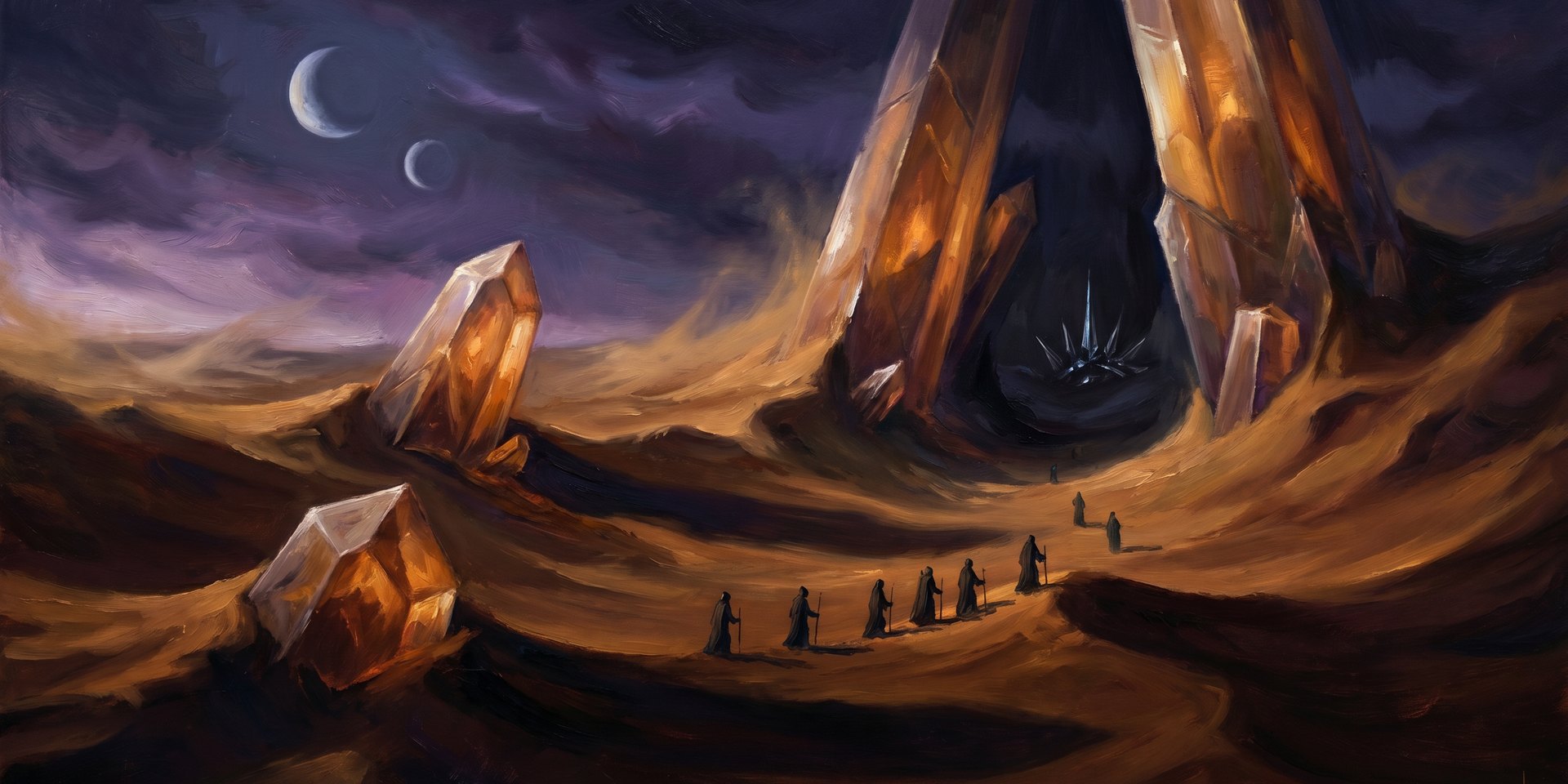

On the eve of interstellar war, seven pilgrims are chosen for a final pilgrimage to the Time Tombs of Hyperion, backwater world of the Hegemony of Man, where legend holds that a three-meter creature of blades and chrome called the Shrike grants one member of each pilgrimage a wish and kills the rest. On the way, each pilgrim tells the story of why they came. A priest, a soldier, a poet, a scholar, a detective, a diplomat: six tales in six different genres, braided into one of the great structural achievements in science fiction.
Simmons published Hyperion in 1989, won the Hugo, and finished the story across three more novels: an immediate conclusion, then a second duology set centuries later. This guide covers all four Cantos, the horror and historical novels that made Simmons impossible to shelve, and where to go when the pilgrimage ends.
Hyperion is the Canterbury Tales of science fiction, and the trick still works
The frame is borrowed from Chaucer and the poet's name from Keats, and the nerve of it remains startling: a space opera assembled from six novellas, each in a different register. The priest's tale is cosmic horror, the soldier's is military SF laced with eros, the poet's is a profane comedy about art, the scholar's is the saddest story the genre has produced, the detective's is cyberpunk noir, the consul's is an elegy. Any one would anchor a lesser book. Together they build a universe by triangulation, and the monster waiting at the end of the road gets scarier with every telling.

From pilgrimage to the far future
- 1989Hyperion sends the seven pilgrims to the Time Tombs Hyperion
- 1990Hyperion wins the Hugo; The Fall of Hyperion completes the war The Fall of Hyperion
- 1996Endymion reopens the universe 274 years later Endymion
- 1997The Rise of Endymion closes the Cantos The Rise of Endymion
- 2003Ilium begins Simmons' Homeric epic on Mars Ilium
- 2007The Terror trades starships for the Arctic pack ice The Terror
- 2018AMC's The Terror brings Simmons to television The Terror
The Hyperion Cantos
Four books, two duologies, one long argument with God


One story in two halves
Read the Cantos as two duologies. Hyperion and The Fall of Hyperion are a single novel split at the spine: the first is the pilgrims' tales, the second is the war those tales were building toward, told while the TechnoCore, the AI civilization that quietly runs humanity's infrastructure, plays its own game. Endymion and The Rise of Endymion jump 274 years to a galaxy remade under a resurgent Church, and follow a young guide named Raul Endymion and a girl who stepped out of the Time Tombs with the future in her head. The first pair is the consensus masterpiece; the second divides readers and rewards the ones who keep going. A fifth Cantos story exists too: the novella Orphans of the Helix, collected in Worlds Enough and Time.
The Shrike is the genre's best monster because nobody explains it too soon
Four arms, a body of chrome thorns, eyes like red furnace glass, and the habit of stepping outside time to take people apart or hang them on a tree of metal spikes. The Shrike works because Simmons holds his nerve: it arrives without an origin, kills without a motive a human can parse, and is worshipped by a church that considers it the instrument of a final atonement. Horror writers know that an explained monster is a dead monster. Simmons, who wrote horror before he wrote space opera, feeds the mystery exactly as fast as it needs and no faster.
Simmons beyond the Cantos
Homer on Mars, ships in the ice, and the horror years


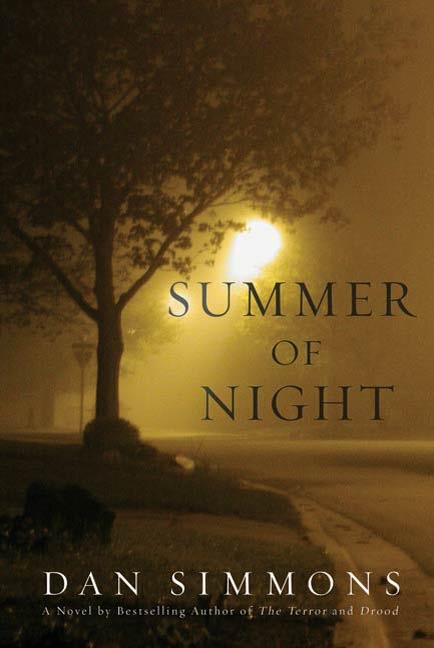

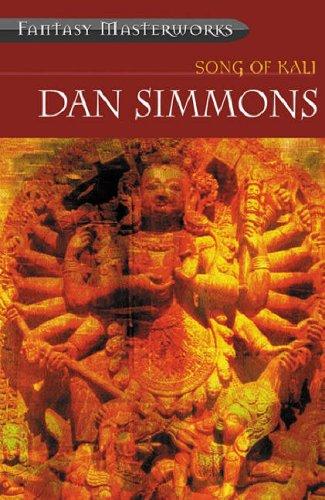
In the beginning was the Word. In the end... past honor, past life, past caring... In the end will be the Word.Martin Silenus, Hyperion
The pilgrim-in-chief
Follow Dan Simmons across space opera, horror and the Arctic.
Worlds that answer Hyperion
The literary space epics, and the one Simmons story that made it to the screen


More epics to undertake
Space Opera
Explore the Space Opera guide →Frequently asked
In what order should I read the Hyperion Cantos?
Publication order, no debate: Hyperion, The Fall of Hyperion, Endymion, The Rise of Endymion. Hyperion ends mid-journey by design, so have The Fall of Hyperion ready. The Endymion duology stands a little apart; many readers stop after the first two books, but the last two resolve the universe's real questions.
What is the Shrike?
A three-meter creature of chrome blades that haunts the Time Tombs on Hyperion, kills without discernible motive, and can move outside of time. A whole church worships it as the Lord of Pain. Its nature and purpose are among the series' central mysteries, and the books reveal them at their own deliberate pace.
Is there a Hyperion movie or TV series?
No. Adaptations have circled for more than fifteen years, from a planned Syfy event series to a Warner Bros. film with Bradley Cooper attached, and none has made it to production. The one Dan Simmons story on screen is season one of AMC's The Terror, from his 2007 Franklin-expedition novel.
What awards did the Hyperion books win?
Hyperion won the 1990 Hugo Award for best novel plus the Locus Award; The Fall of Hyperion and The Rise of Endymion each won the Locus Award for best science fiction novel as well. The series regularly places near the top of best-space-opera polls.
How does John Keats fit into the series?
Everywhere. The titles come from Keats' poems, the unfinished epic Hyperion and the romance Endymion, one pilgrim is entangled with a reconstructed personality of the poet himself, and the series' obsessions, beauty, dying young and what art is for, are Keats' own. You need no Keats to enjoy the books, but he deepens every reread.