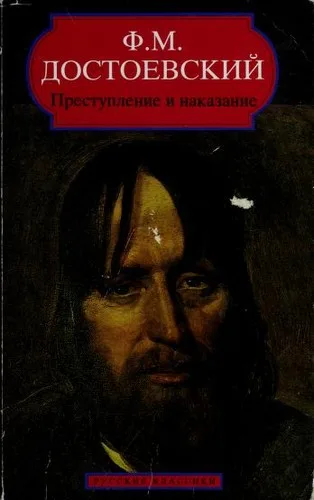
Crime and Punishment (1884)
Crime and Punishment is a 1884 Russian-language english translations book written by Fyodor Dostoyevsky.
Rodion Raskolnikov has a theory about himself that he needs to test. A former student rotting in a rented attic in St Petersburg, unable to pay for it and unable to stop thinking, he has argued his way to the position that history's extraordinary men stand outside ordinary morality and may spill blood if the ledger comes out ahead. To find out which kind of man he is, he plans to kill a pawnbroker for her cash.
Dostoyevsky spends very little of the book on the act. Almost everything happens in the mind before and after it, in a summer city of stairwells, taverns and fever where every conversation seems designed to walk Raskolnikov one step closer to saying the thing he must not say. A magistrate circles him without ever quite accusing. The people he meets keep pressing a claim his theory has no answer for, which is that other lives are not arithmetic.
It ran in twelve monthly installments in the journal The Russian Messenger through 1866, the second full-length novel Dostoyevsky finished after ten years of exile in Siberia and the first of his mature period. It still moves at thriller speed. It is also far more embarrassing and more physical than its reputation suggests, since Raskolnikov is not a cool criminal; he is a young man who keeps fainting.
Similar books
Explore Crime and Punishment guides
A few thoughts on Crime and Punishment
The real subject is a man who cannot live inside his own reasoning, so the best companions sit in a guilty head rather than solve a case. Captain Volkonogov Escaped gives that a modern Russian shape, a servant of the state going door to door carrying a conscience he cannot put down. The Flowers of Evil shrinks the same spiral to a provincial teenager whose small transgression eats him alive. Maoh: Juvenile Remix takes up Raskolnikov's exact question, whether extraordinary people are permitted extraordinary means. For the novel in other forms, Crime and Punishment carries it into manga, and Crime and Punishment gives Peter Lorre the attic and the fever.
Crime stories where the guilt matters more than the case
Crime and Punishment spends barely a page on the murder and hundreds of them on the mind before and after it. These reads follow suit: detectives and killers undone less by evidence than by conscience, dread, and memory, where the real pursuit happens inside the head of someone who cannot outrun what they did.
Investigators who let the guilty unravel themselves
Porfiry Petrovich never has to arrest Raskolnikov in Crime and Punishment; he just keeps talking until the guilt does his work for him. These mysteries share that patient method: quiet, watchful detectives who close in through conversation and small contradictions rather than force, waiting for the suspect to give himself away.
Big ideas that talk a person into terrible things
Raskolnikov kills to prove a theory, that extraordinary men stand above ordinary morality, and Crime and Punishment tests the idea to destruction. These books run the same experiment: characters who reason their way toward cruelty or ruin, and the philosophies of freedom, power, and conscience that carry them there.
Crime born of a hard and unequal city
Before the theory, Raskolnikov is simply broke and starving in a St. Petersburg attic, and Crime and Punishment never lets you forget that poverty set the crime in motion. These stories keep that ground in view: desperate people, cheap violence, and the grinding pressure of money in worlds that offer them no other exit.