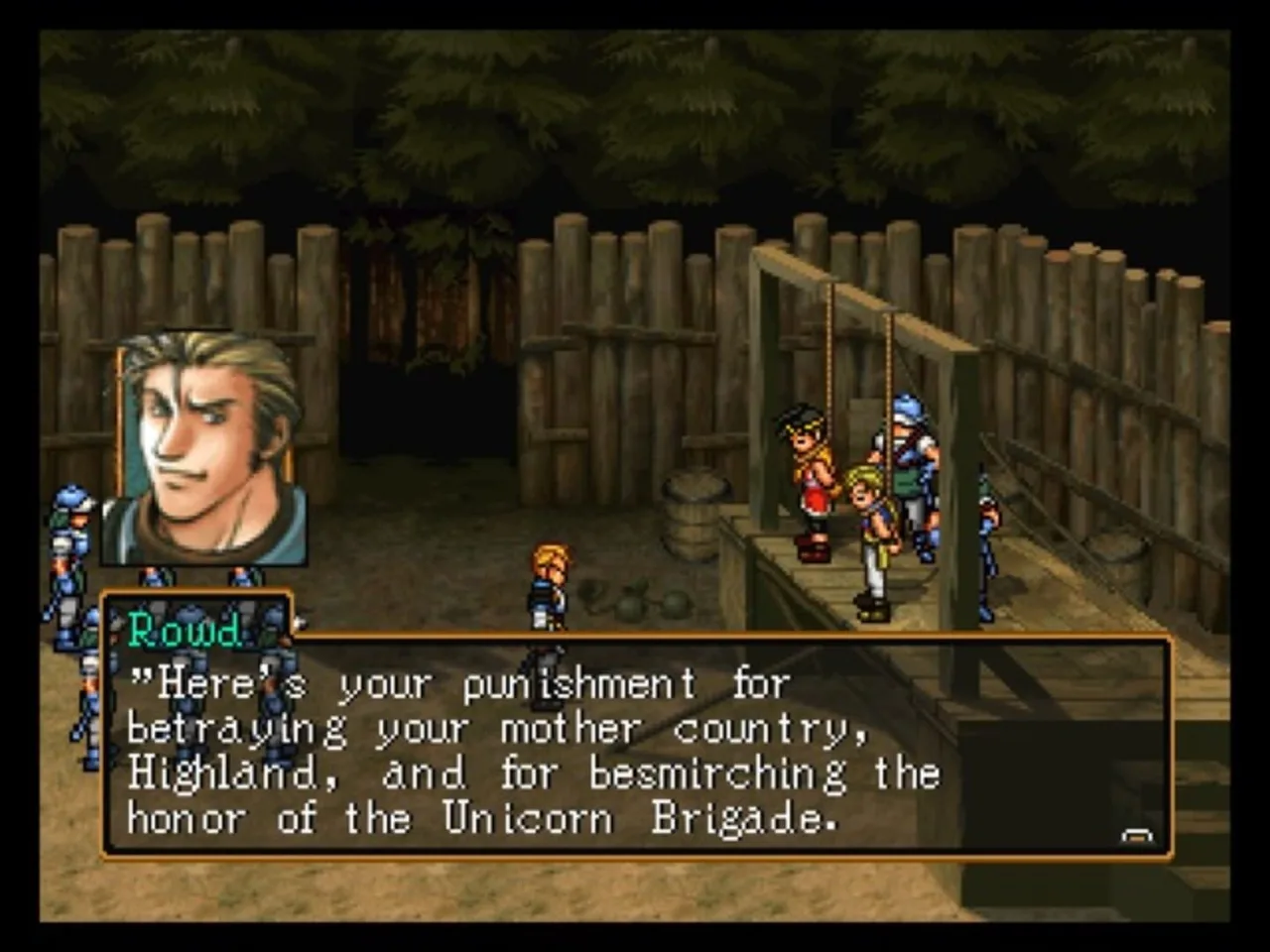
Suikoden II (1998)
Suikoden II is a 1998 role-playing (rpg) video game made by Konami.
The Highland Kingdom and the City-States of Jowston have been at war for years. Riou, a young soldier in a Highland youth brigade, survives a massacre and finds himself a fugitive from the empire he served, sheltered by the resistance he was trained to fight. Over 108 recruitable characters, Suikoden II tells a story about the weight of friendship under political pressure, building toward a conflict that has no clean villain. Tactical army battles run alongside the series' intimate six-person turn-based combat, and save data from the original Suikoden unlocks additional story threads that tie the two games together.
Similar games
Explore Suikoden II guides
Suikoden II in our writing
A few thoughts on Suikoden II
Mass Effect 2 builds a similar emotional architecture: assembling a loyal team from opposing factions, with every relationship carrying weight before the final confrontation. Both games are at their best when loyalty and ideology pull characters in different directions.
Sprawling wars where both sides have a case worth hearing
Suikoden II never lets Highland or Jowston fully own the moral high ground, and Riou spends the whole war serving an alliance he inherited rather than one he chose. Game of Thrones, House of the Dragon, The Return of the King, Vikings and The Witcher 3 build their conflicts the same way, with leaders worth arguing for on both sides and battles that cost something real.
Ensemble casts that keep adding faces worth remembering
Suikoden II's 108 Stars of Destiny turn recruitment itself into the plot, and every new ally reshapes the castle and the war effort a little more. Saint Seiya, Sailor Moon, Hunter x Hunter, Miraculous: Tales of Ladybug & Cat Noir and Redwall all lean on the same trick, a widening circle of allies with distinct skills and real reasons to fight until the group feels like a small society.
Trained soldiers who turn against the power that made them
Riou is raised inside Highland's military only to become a fugitive from it, fighting the empire that trained him instead of the enemy it once pointed him at. The Song of Achilles, Wizard and Glass, Brisingr, God of War and Peaky Blinders all follow soldiers whose skills were built by an institution they eventually turn against.
Small resistances standing up to an empire twice their size
Riou's rebellion starts as a scattered handful of defectors, nowhere near a match for Highland's standing army, and Suikoden II treats that imbalance as the whole point of the early war. Asterix, Dororo, the Stormcloak uprising in Skyrim, Assassin's Creed II and The Boys all put a small, determined group up against a far larger power structure and let scale itself be the obstacle.