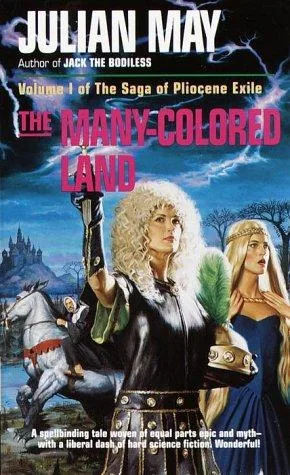
THE MANY-COLORED LAND (1981)
THE MANY-COLORED LAND is a 1981 american science fiction book written by Julian May.
By the twenty-second century, a one-way time gate offers Earth's misfits an exit: step through to the Pliocene, six million years back, and never return. Julian May sends a ragtag band of dropouts, romantics and malcontents into that deep past expecting wilderness and solitude. What they find instead is a world already claimed by others, with its own politics, hierarchies and appetites. This first book of the Saga of Pliocene Exile lays out its sprawling cast and strange rules, mixing hard science, myth and character study into an ambitious opening move for a much larger story.
Similar books
Explore THE MANY-COLORED LAND guides
A few thoughts on THE MANY-COLORED LAND
Genre travelers should beam over to Stargate SG-1, whose gateway drops explorers into worlds ruled by ancient powers, and Interstellar for its awe at deep time and vast distance. Mass Effect 2 shares the sprawling ensemble and alien politics, while the manga epics Galaxy Express 999 and Phoenix carry the same grand, time-spanning ambition.
Exiles who step into a wilder world and cannot go back
Julian May's misfits walk through a one-way time gate into the Pliocene expecting empty wilderness, and never plan to return. These stories share that irreversible step, groups cast into a raw, unfamiliar world where survival means learning its rules fast. Some flee ruined futures, others are sent as punishment, all of them build new lives in a land indifferent to who they were.
Hard science fiction chasing deep time and lost makers
Julian May threads real science through myth, sending her cast six million years back to a world already claimed by others. These picks share that appetite for big ideas, hard science fiction that reaches across deep time and vast distance toward civilizations we barely understand. The speculation stays rigorous even as the human questions underneath it grow harder.
Sprawling sagas where a new world runs on old power games
The Pliocene the exiles reach is no blank slate, it already has politics, hierarchies, and appetites they walk straight into. These sprawling sagas share that scale, huge casts jockeying for power inside worlds governed by faction, bloodline, and force. As an opening move in a much larger story, The Many-Colored Land sets its board the way these epics do.
Science fiction epics that reach for myth
May mixes hard speculation with myth and deep character study, giving her Pliocene saga a legendary weight. These comics work that seam too, science fiction drawn on a mythic scale across generations, ruins, and reincarnations. They pair rigorous invented worlds with the sweep of old stories, exactly the register that makes the Saga of Pliocene Exile feel ancient and new at once.