Where Should You Start With Dolly Parton?
Dolly Parton died on August 25, and the first useful thing to say about her work is that it never demanded a single correct entrance. You could arrive through a country song heard in a kitchen, a pop cover on the radio, a comedy playing on television, or a harmony record passed across generations. The official statement from Dollywood asks us to remember what she gave. A practical way to do that is to enter the work itself, choosing the door that already feels open and trusting that it will lead to the others.
Her public image was vivid enough to become shorthand, but the songs kept complicating it. A plea to a romantic rival makes jealousy sound like close observation rather than possession. A childhood memory turns poverty into an argument about the value a family gives an object. A farewell ballad separates love from ownership with startling calm. The Country Music Hall of Fame's account of her career places songwriting at the foundation, before the crossover records, films, theme park or global iconography. Start there and the apparent contradictions begin to look like one consistent intelligence at work.
Door one is the country writer. Put on 9 to 5 and Odd Jobs and listen for how work enters the songs: who does it, who benefits from it, how humor keeps fatigue from becoming surrender. The famous title song is immediate, but the album around it broadens the idea of labor beyond a slogan. Parton's gift was to make craft disappear into conversation. A clean rhyme or bright hook could carry a precise social observation without announcing that it was doing important work. Give this door one uninterrupted album, then return to her spare early hits with the writer, not only the singer, at the center of your attention.
Door two is shared harmony. Trio, made with two fellow country voices, is the ideal correction to the idea of Dolly as a solitary monument. Listen to the blend rather than waiting for one singer to dominate it. The pleasure comes from distinction held inside cooperation, three recognizable presences adjusting to one another without losing their grain. That makes the record a lesson in Parton's broader appeal. She could be unmistakable without requiring every song, scene or room to belong to her alone. The welcome in her work was not vague niceness. It was an arrangement principle.
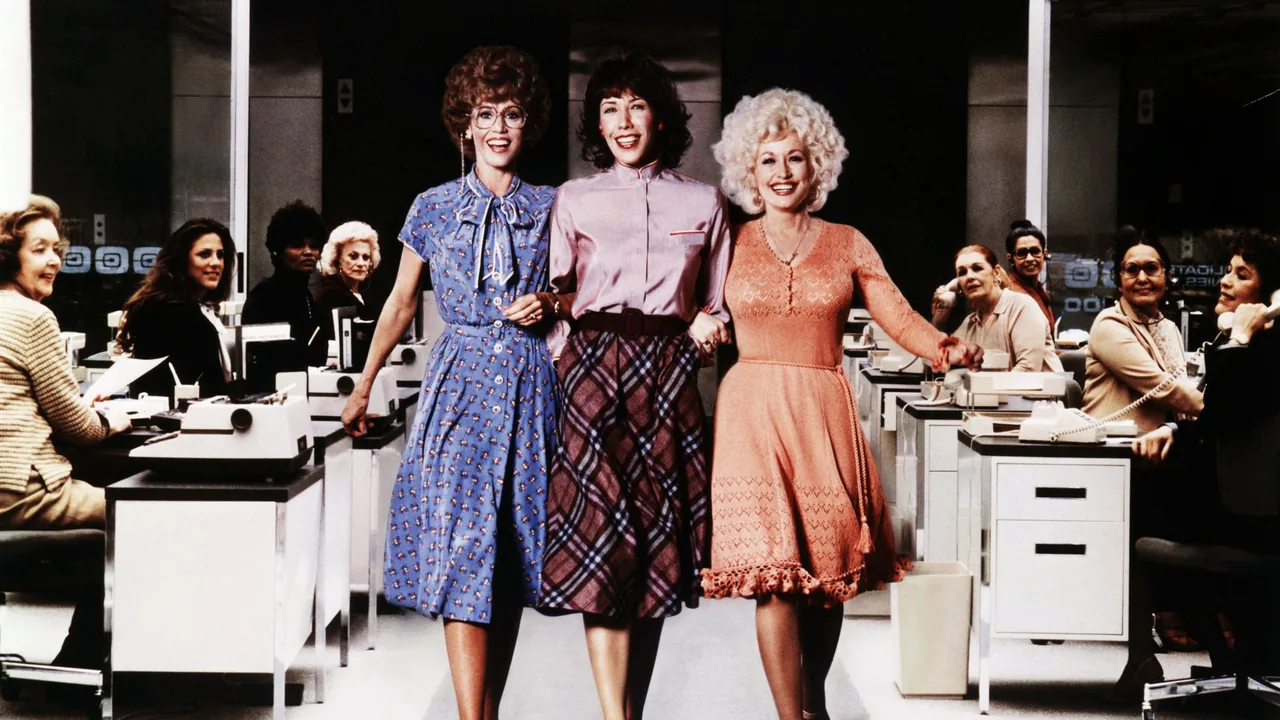
Door three is screen comedy, and Nine to Five is the obvious threshold. Watch how Parton uses directness. She does not treat comedy as a disguise for seriousness, or seriousness as an excuse to stop being funny. The film's workplace anger remains accessible because the performers turn solidarity into rhythm. From there, The Best Little Whorehouse in Texas shows a larger musical-screen persona, while Steel Magnolias places her inside an ensemble where wit is a form of care. Across all three, the useful through line is attention to other people. Her characters register what a room needs before they announce what they need from it.
The screen door also opens toward later work. Dolly Parton's Heartstrings treats songs as narrative seeds, making explicit what her listeners had always known: a compact lyric can imply a whole town of histories and decisions. Dumplin' uses her music and cultural presence as permission for a younger character to imagine confidence on her own terms. Neither needs to be your first encounter. Both are useful after the classic films because they reveal how later storytellers received Dolly, not merely as a celebrity cameo but as a language for courage, humor and self-invention.
Door four is the song that travels beyond its writer. Watch The Bodyguard and hear what Parton's farewell ballad became in Whitney Houston's performance. The Library of Congress has traced the copyright story connecting Parton's writing to Houston's recording, a reminder that authorship and transformation can coexist without reducing either artist. Parton's original and Houston's version do different emotional work. One clears a room for departure. The other fills an arena with the scale of that departure. Listening to both is a lesson in how generous songwriting survives reinterpretation because its structure is strong enough to welcome another person's power.
That fourth door also points back toward homecoming. Parton's returns to roots-oriented country and bluegrass were not retreats from pop achievement. They showed that crossover had never erased the older musical grammar beneath it. You can hear the same respect for a clean story, a memorable melodic turn and musicians responding to one another. If your entrance was the pop icon, travel backward. If your entrance was Appalachian songwriting, travel forward into the screen work. The catalog does not split neatly into authentic Dolly and commercial Dolly. Her intelligence lay in making those categories talk to one another.
So choose by appetite. For one focused album, begin with 9 to 5 and Odd Jobs. For voices in communion, choose Trio. For a movie night, start with Nine to Five, then let Steel Magnolias show how her comic timing could become communal warmth. For the afterlife of a song, pair Parton's original recording with The Bodyguard and listen for what changes when another extraordinary singer inhabits it. This is not a ranking, and grief does not need homework. It is a map for anyone who wants remembrance to become attention.
The best memorial to a generous body of work is use. Play the record for someone who only knows the chorus. Put on the comedy with a person who needs its collective nerve. Follow a familiar song toward the album or film you have never tried. Parton left country songwriting, pop crossover, screen comedy and roots music connected by an unusual promise: accessibility did not require shallowness, and welcome did not require sameness. There is more than one way in because she spent a lifetime leaving the doors open.