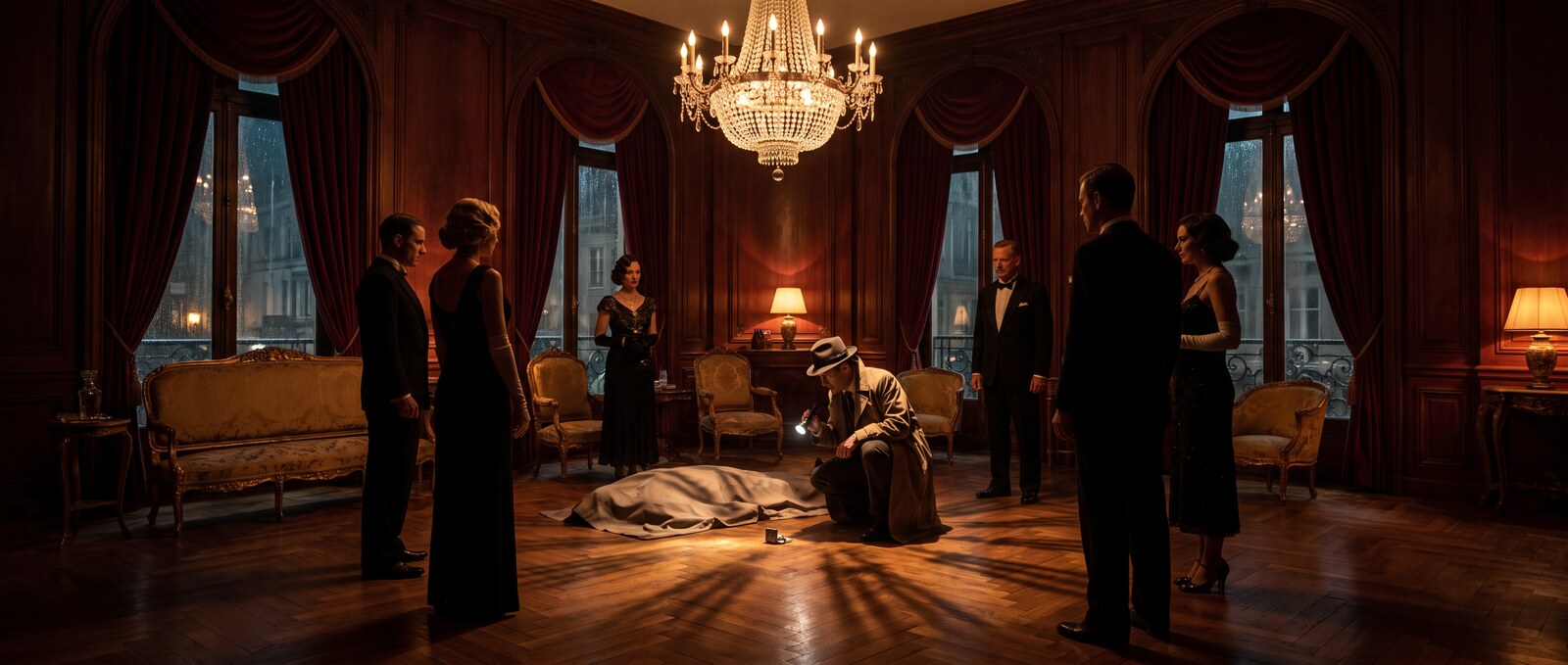

The locked-room mystery is the purest puzzle in fiction: a murder that could not possibly have happened, in a room no one could have entered or left, solved by pure reasoning. Edgar Allan Poe invented it in 1841, the Golden Age of Christie, Sayers and John Dickson Carr turned it into a national pastime, and Japanese honkaku writers rebuilt it as an elaborate fair-play machine. Today Rian Johnson's Knives Out and games like Return of the Obra Dinn prove the impossible crime is more alive than ever.
This is the complete guide across every medium: the Golden Age masters, the whodunit on film, the deduction games that put the magnifying glass in your hand, the great TV detectives, the Japanese puzzle mysteries, and the Sherlock Holmes stories where it all began.
The essential impossible crimes




The Golden Age masters


Knives Out brought the whodunit roaring back
Rian Johnson understood that the murder-mystery had never really died, it had just been waiting for someone to play it straight and sharp at once. He built a perfect Christie-style machine, a rambling mansion, a dead patriarch, a circle of awful relatives, and then handed it to a detective as delighted by the game as we are. It was a box-office phenomenon that single-handedly revived the star-studded whodunit and reminded studios that a good puzzle sells.
The whodunit on film



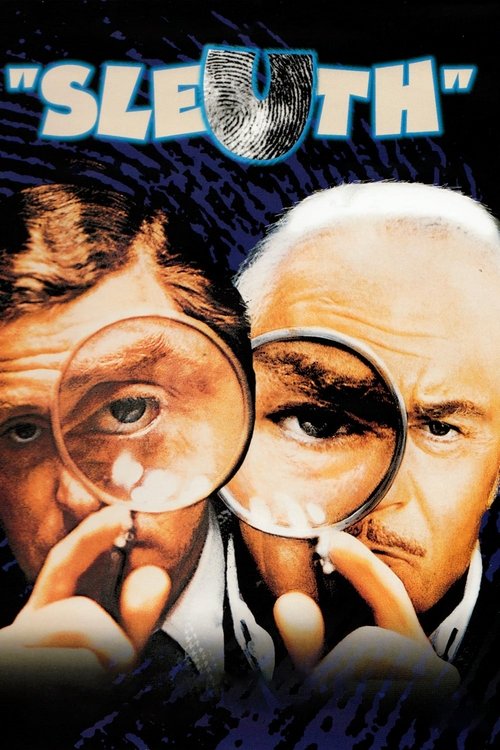

Solve it yourself: the games






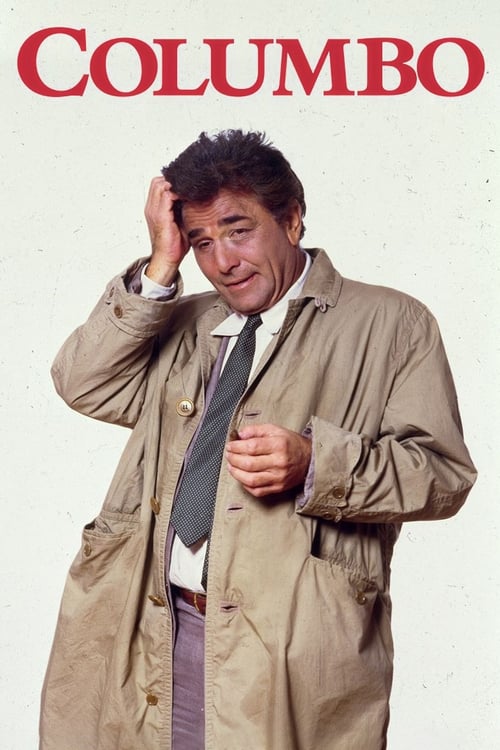
The great detectives on TV




Return of the Obra Dinn is the greatest deduction game ever made
Lucas Pope gives you a pocket watch that shows the moment of a person's death and a ledger of sixty souls to identify, and asks you to reason out every fate aboard a doomed ship from posture, accent and context alone. Its stark one-bit art and its refusal to hold your hand make the act of deduction feel earned in a way no other game manages. When the pieces finally lock, it is the purest version of the detective's thrill.
The honkaku: Japanese puzzle mysteries


Modern impossible crimes

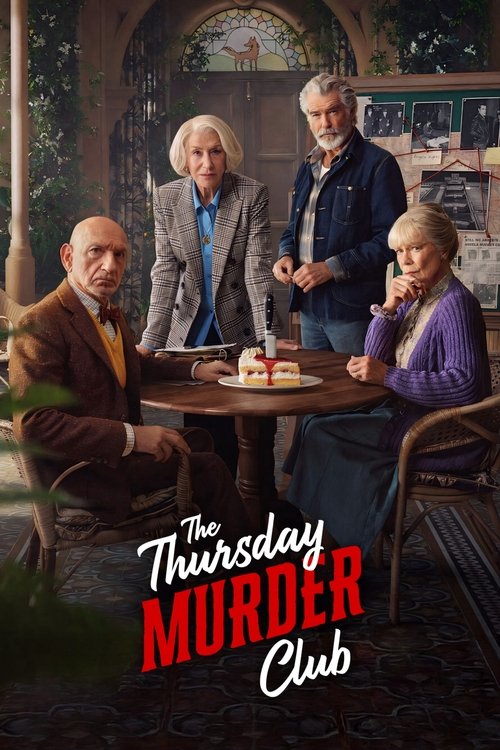

Sherlock Holmes and the origins



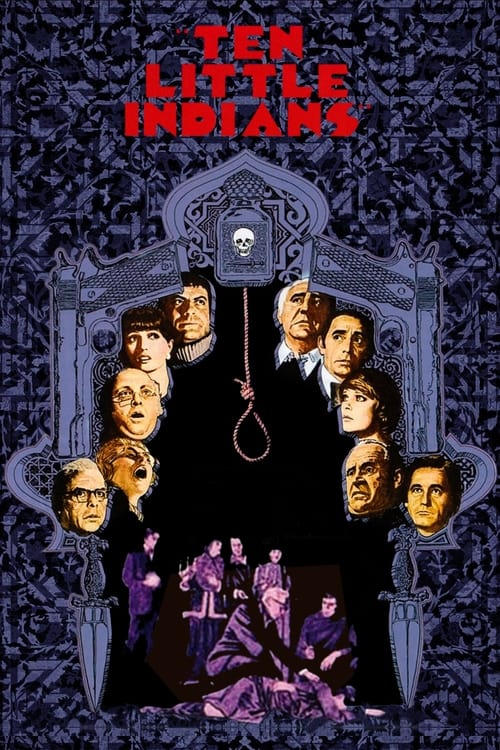
And Then There Were None is the perfect closed-circle mystery
Ten strangers are lured to an island, cut off from the world, and killed one by one by an unseen hand that must be among them. Agatha Christie strips the form down to its bones, no detective, no rescue, no escape, and the result is the best-selling mystery novel of all time. Every closed-circle story since, from Danganronpa to Glass Onion, is playing in the room she built.
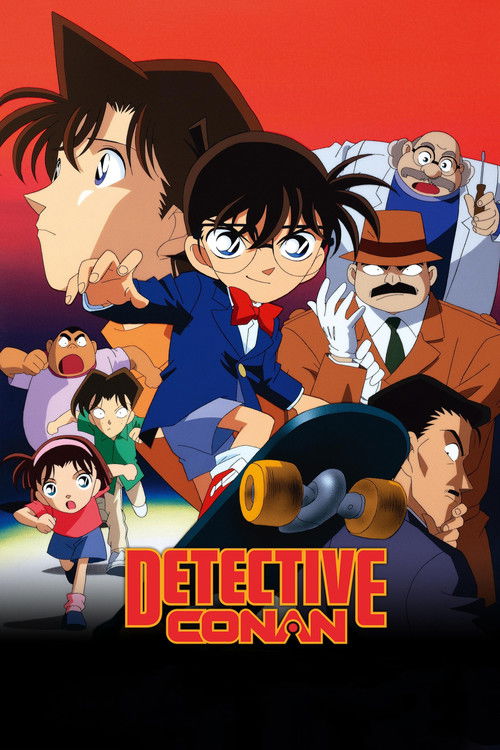
Murder mysteries in anime





The timeline
- 1841Edgar Allan Poe's The Murders in the Rue Morgue invents the locked-room mystery and the detective story. The Murders in the Rue Morgue
- 1868Wilkie Collins's The Moonstone establishes the full-length detective novel. The Moonstone
- 1887Arthur Conan Doyle introduces Sherlock Holmes in A Study in Scarlet. A Study in Scarlet
- 1907Gaston Leroux's The Mystery of the Yellow Room perfects the impossible crime. Mystery of the Yellow Room
- 1926Agatha Christie stuns readers with the twist of The Murder of Roger Ackroyd. The Murder of Roger Ackroyd
- 1935John Dickson Carr's The Hollow Man delivers the definitive locked-room lecture.
- 1939And Then There Were None becomes the best-selling mystery novel ever written. And Then There Were None
- 2005Keigo Higashino's The Devotion of Suspect X revives the honkaku puzzle mystery. The Devotion of Suspect X
- 2018Return of the Obra Dinn turns pure deduction into a landmark video game. Return of the Obra Dinn
- 2019Rian Johnson's Knives Out brings the star-studded whodunit roaring back. Knives Out
One-room and closed-circle thrillers




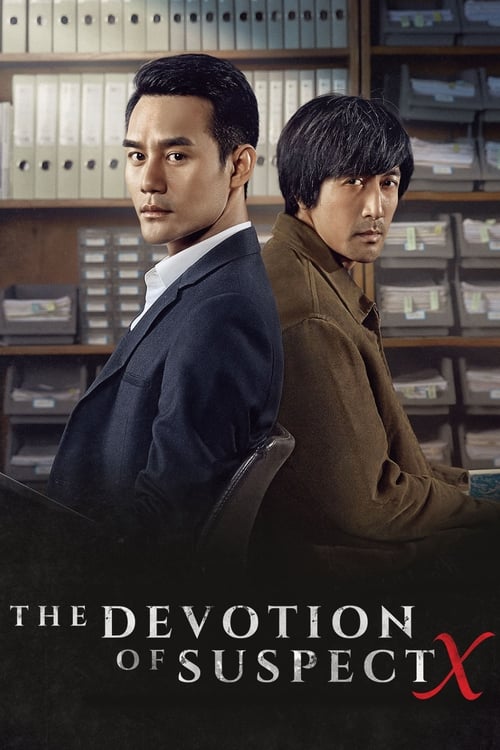
The Devotion of Suspect X is the modern honkaku masterpiece
Keigo Higashino takes the fair-play puzzle and fuses it with genuine tragedy: you know who did it from the first pages, and the mystery is how a devoted mathematician conceals it. It is a locked-room story about the human heart, plotted with ruthless precision and resolved with a gut-punch. More than any other book, it carried the Japanese puzzle mystery to the rest of the world.
The masters of misdirection
Keep exploring
Detective & Mystery
Explore the Detective & Mystery guide →Frequently asked
What is a locked-room mystery?
A locked-room mystery is a type of detective story in which a crime, almost always a murder, is committed under seemingly impossible circumstances: a victim found in a room locked and sealed from the inside, or in a place no culprit could have entered or left. The pleasure lies in the detective revealing the ingenious, rational method behind the apparent impossibility. It is a subgenre of the broader whodunit.
What is the first locked-room mystery?
Edgar Allan Poe's 1841 short story The Murders in the Rue Morgue is generally credited as the first locked-room mystery and the first modern detective story. It introduced the brilliant amateur detective (C. Auguste Dupin) solving an apparently impossible crime through observation and deduction, a template Arthur Conan Doyle and countless others would follow.
What is honkaku?
Honkaku (orthodox) is a Japanese school of detective fiction devoted to the fair-play puzzle mystery: intricate, logically solvable crimes where the reader has every clue the detective does. Writers like Seishi Yokomizo, Soji Shimada, Yukito Ayatsuji and Keigo Higashino kept the classic puzzle mystery thriving in Japan long after it faded in the West, and translations have made it globally popular.
Where should I start with locked-room mysteries?
For books, Agatha Christie's And Then There Were None or John Dickson Carr's The Hollow Man; for Japanese honkaku, The Devotion of Suspect X or The Decagon House Murders. For film, Knives Out. For games, Return of the Obra Dinn or The Case of the Golden Idol. For TV, the David Suchet Poirot series.