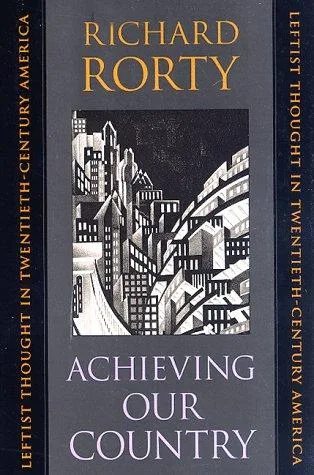
Achieving our country (1998)
Achieving our country is a 1998 history book written by Richard Rorty.
A philosopher turns on his own side. Richard Rorty splits twentieth century American leftism into two traditions and argues that the more useful one has gone quiet.
One tradition is reformist, and Rorty traces it through John Dewey: pragmatic, set on concrete gains, willing to take pride in the country as an unfinished job. The other is the cultural left, which he locates in the universities after Vietnam and exemplifies with Michel Foucault and Jean-Francois Lyotard. Rorty grants that its diagnoses of American life land. His complaint is that it puts no program in their place, treats progress itself as suspect, and has taught a generation to hear patriotism as an endorsement of slavery, conquest and war.
The quarrel between the Old Left and the New during Vietnam sits at the center of the argument. Rorty reads the antiwar movement's victory as a strange one, arriving with the Nixon years and pushing disillusioned intellectuals toward High Theory and away from the ordinary business of politics.
Adapted from his 1997 Massey Lectures, the book keeps the speaking voice: direct, combative, light on jargon, pitched past the philosophy department. The case belongs to Rorty, and he argues it as a participant rather than as an observer.
Similar books
Explore Achieving our country guides
A few thoughts on Achieving our country
The People Speak tells the American record through its dissenters, with actors performing letters and speeches gathered by Howard Zinn, which makes it a live test of Rorty's question about how the left should narrate the country. Oliver Stone's Untold History of the United States runs the same material at length and lands closer to the reading Rorty resists, so it serves better as a sparring partner than as a companion. The Seventies covers the decade where he locates the break, from the end of Vietnam through Watergate, in news footage instead of argument. For the reformist temperament he wants back, Where to Invade Next does the pragmatist thing: Michael Moore looks for policies that already work in other countries and asks what stops the United States from copying them.