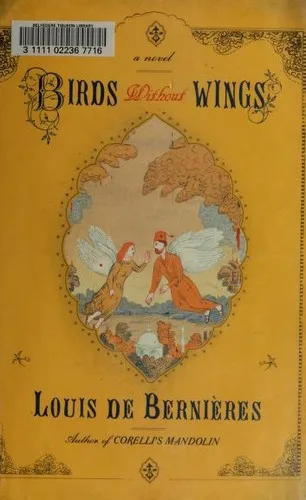
Birds Without Wings (2004)
Birds Without Wings is a 2004 historical fiction book written by Louis de Bernières.
In the village of Eskibahçe in southwestern Anatolia, Christian Greeks and Muslim Turks share wells, festivals and a speech stitched together from both tongues. Louis de Bernières sets his 2004 novel there, in the last decades of the Ottoman Empire, and lets the village talk for itself: potters, priests, imams, landowners and children take the narration in turn, so the place assembles out of gossip and memory rather than one omniscient account.
Two strands run through it. One follows Philothei, a Christian girl, and Ibrahim, the Muslim boy promised to her since childhood. The other tracks Mustafa Kemal Atatürk from a provincial boyhood toward the founding of a Turkish nation, chapters written as sober biography against the villagers' ordinary days.
De Bernières writes the First World War trenches in unsparing detail, then follows the Greco-Turkish War as it reaches communities like this one, with expulsions and massacres ending centuries of shared life in Anatolia. The novel names the engines plainly, religious intolerance and a zealous new nationalism, and keeps the villagers where they stood, inside tides they never chose.
Readers of Captain Corelli's Mandolin will meet a few familiar names; the two novels share a subject and a method without forming a series. Iskander the Potter gives the book its title: man is a bird without wings, and a bird is a man without sorrows.
Similar books
Explore Birds Without Wings guides
A few thoughts on Birds Without Wings
The Water Diviner covers this ground from the other side of the line. An Australian farmer returns to Gallipoli in 1919 to look for his sons, and the film shows a Turkey remade by the same war and the same new nationalism. Kurt Seyit & Sura is a Turkish series set in those years, a romance running straight into revolution, exile and the collapse of the old order, with the sweep de Bernières gives the village. For the method rather than the setting, Maus tells one community's destruction through a single family's testimony, and it keeps history at human scale the way the village chapters do. Louis Riel handles the biographical half: Chester Brown on a leader trying to build a nation for his people, told with the plainness de Bernières brings to the Atatürk chapters.