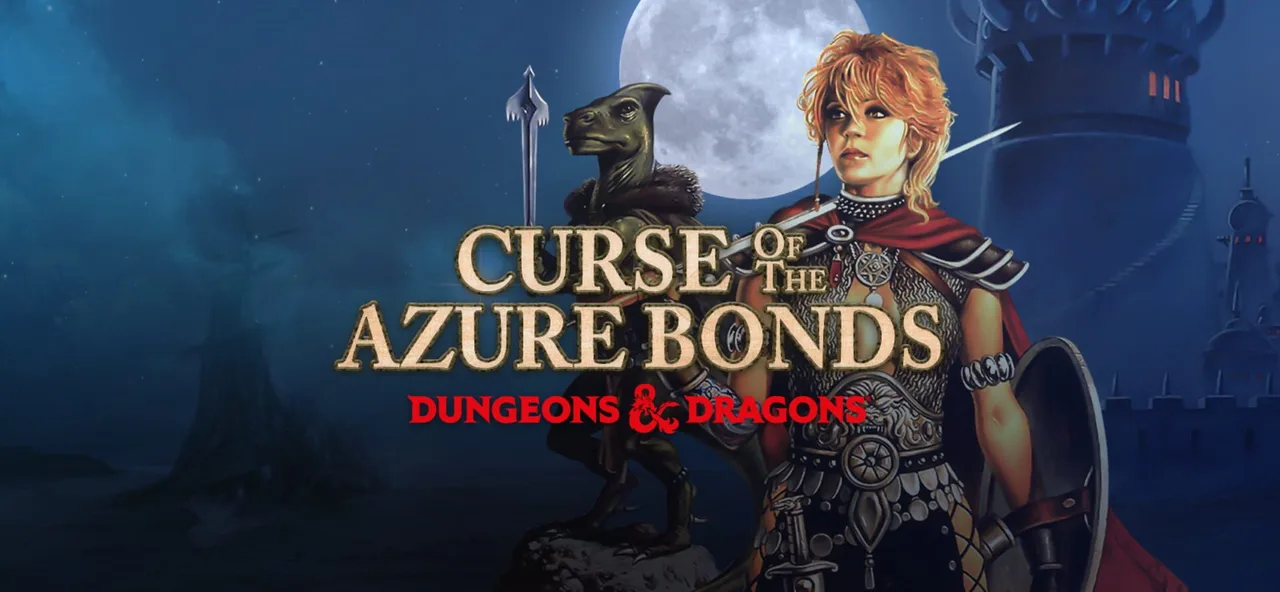
Curse of the Azure Bonds (1989)
Curse of the Azure Bonds is a 1989 role-playing (rpg) video game made by SSI (Strategic Simulations, Inc.).
The heroes wake in Tilverton with no memory of their capture and five glowing blue sigils burned into their swordarms. Each azure bond can seize control of a limb or a will at the worst moment, and the party sets out across the Dalelands and the kingdom of Cormyr to learn who marked them and why. SSI's Gold Box sequel to Pool of Radiance runs turn-based Advanced Dungeons & Dragons combat on a tactical grid, the closest a computer came to the tabletop in 1989. Character transfer carries your veterans forward, scars and all, into a longer, meaner Forgotten Realms campaign.
Similar games
Explore Curse of the Azure Bonds guides
Curse of the Azure Bonds in our writing
- Companion guide: The Golden Age of the CRPG: 1981 to 1999
- Companion guide: Dungeons & Dragons on the PC: From the Gold Box to Baldur's Gate 3
A few thoughts on Curse of the Azure Bonds
This is prime Gold Box, and the saga continues directly in Secret of the Silver Blades, which imports your marked veterans. Newcomers to tactical D&D should also try Baldur's Gate for a real-time-with-pause evolution of the same Forgotten Realms adventuring, and the film Dungeons & Dragons: Honor Among Thieves for the tone of a cursed party bluffing through the Realms.
A party you carry forward from game to game
Curse of the Azure Bonds picks up your exact party from Pool of Radiance, scars and all, and asks them to survive a longer, meaner Forgotten Realms campaign. That same thread, a roster you build once and keep, runs through Baldur's Gate II's imported hero, Neverwinter Nights' persistent characters, Icewind Dale's built-from-scratch company, and Eye of the Beholder II's carried-over adventurers.
Turn-based D&D tactics on a grid
Curse of the Azure Bonds fights its way across the Dalelands one turn at a time, AD&D rules translated straight onto a tactical grid, the same rhythm Temple of Elemental Evil and Solasta rebuilt decades later for a new audience. Baldur's Gate III, Pathfinder: Wrath of the Righteous, and Pathfinder: Kingmaker all let you drop into that same grid-and-initiative combat whenever a fight gets serious.
D&D's Forgotten Realms and other tabletop fantasy on screen
Curse of the Azure Bonds sends its company across the Forgotten Realms, the same setting Dungeons & Dragons: Honor Among Thieves and The Legend of Vox Machina brought to screen decades later. Stranger Things builds a whole strand of its story around kids running their own tabletop campaign, and The Witcher and Blood of Elves ground a similar traveling party of adventurers in a different fantasy world entirely.
Old-school PC RPGs from before real-time 3D took over
Curse of the Azure Bonds comes from a stretch of PC RPGs where turn-based grids and stat sheets did the work modern graphics do now. Baldur's Gate and Planescape: Torment carried that same design forward with deeper story, Ultima IV and Ultima VII built entire worlds around exploration and a virtue system, Betrayal at Krondor leaned into puzzle-heavy quests, and Fallout carried the formula into a post-apocalyptic wasteland.