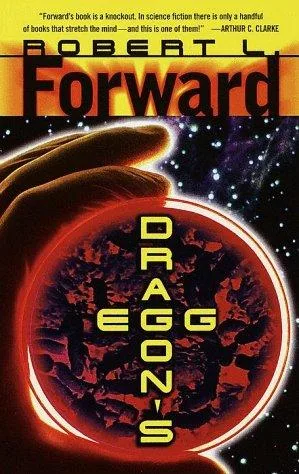
Dragon's egg (1980)
Dragon's egg is a 1980 american science fiction book written by Robert L. Forward.
A neutron star the size of a small mountain, spinning fast, its surface gravity sixty-seven billion times Earth's. On its crust live the cheela, creatures the size of sesame seeds who think and evolve a million times faster than humans. Robert Forward, a physicist, builds the whole novel from real astrophysics, then watches an entire civilization rise from first agriculture to spaceflight inside a single human observation window. Human scientists in orbit make contact and become, briefly, teachers to a species already outrunning them. Rigorous, strange, and genuinely moving in its long view of what intelligence is and how fast it can grow.
Similar books
Explore Dragon's egg guides
Dragon's egg in our writing
A few thoughts on Dragon's egg
Robert L. Forward cares about the physics first, so Interstellar Interstellar is the natural screen companion, wringing its drama from gravity and time dilation the same way. Gamers chasing that sense of meeting genuinely alien minds can turn to Mass Effect 2 Mass Effect 2, where first contact and xeno-biology drive the whole galaxy, one strange species after another.
Hard science fiction that takes real physics seriously
Robert Forward built Dragon's Egg from real astrophysics, and these share that commitment to the science actually working. Interstellar spends its runway on real relativity and wormhole physics, 2001: A Space Odyssey grounds its evolutionary leap in hard technical detail, Contact adapts Carl Sagan's own scientist-first novel, and Project Hail Mary and Old Man's War keep their science plausible even at extreme scales.
First contact stories where humans are the less advanced side
Dragon's Egg turns first contact into an exchange between vastly different lifeforms, and these lean into that same asymmetry. Mass Effect 2 sends humans into a galaxy already run by older alien species, Stargate SG-1 stumbles onto ancient alien technology beyond Earth's reach, War of the Worlds remains the genre's founding invasion story, and Avatar: Fire and Ash centers a civilization more attuned to its world than its human visitors.
Physics-driven puzzle games where the rules never cheat
Dragon's Egg never breaks its own physics even as it accelerates a civilization's history, and these games hold to the same rigor in their mechanics. Portal and Portal 2 build every puzzle from consistent, stated rules about momentum and space, while Half-Life and Half-Life 2 root an alien invasion in believable engineering and real-feeling physics rather than magic.
Concept albums that turn deep space into a story
Dragon's Egg spins its entire plot from cosmology, and these albums build whole records around the same wide-angle universe. Muse's Black Holes and Revelations and Simulation Theory both lean on space and simulated-reality imagery, Deltron 3030's hip-hop concept album imagines a future ruled by artificial intelligence, and Ayreon's Universal Migrator, Part 2 tells its rock-opera story from an alien's point of view.