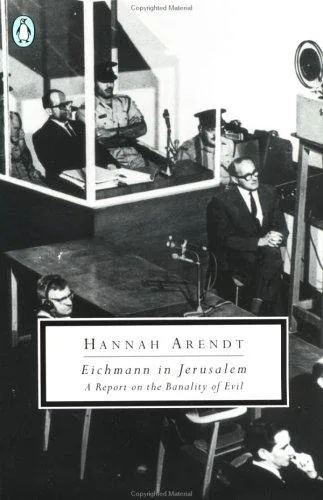
Eichmann in Jerusalem (1963)
Eichmann in Jerusalem is a 1963 history book written by Hannah Arendt.
In 1961 Israeli agents brought Adolf Eichmann, a chief logistician of the Nazi genocide, to trial in Jerusalem. Hannah Arendt, a German Jewish philosopher who had fled Hitler's Reich, covered the proceedings for The New Yorker. Inside the glass defendant's booth she found not a monster but a mediocre functionary who followed orders and spoke in clichés, a man she judged thoughtless rather than diabolical. From that observation came her famous and hotly contested phrase, the banality of evil. The book stands as a hard, clear-eyed argument about conscience, obedience, and how ordinary people come to administer atrocity.
Similar books
Explore Eichmann in Jerusalem guides
A few thoughts on Eichmann in Jerusalem
Margarethe von Trotta's film Hannah Arendt dramatizes this very reporting and the firestorm it set off. For the machinery of the genocide told in survivors' own words, Claude Lanzmann's Shoah is the essential screen companion, while The Act of Killing turns Hannah Arendt's question about ordinary perpetrators toward a very different set of killers.
Films that ask how ordinary people become instruments of atrocity
Arendt sat through Eichmann's trial expecting a monster and found a mediocre man who spoke in clichés, coining the phrase banality of evil. The Act of Killing sits former death-squad leaders down to reenact their own crimes, Shoah assembles the machinery of genocide from witness testimony, and Hannah Arendt dramatizes her own reporting on the trial, while Oppenheimer asks the same question of a brilliant, complicit man.
Games about serving an organization whose cause you stop trusting
Eichmann's defense rested on having simply followed the orders of an organization bigger than himself, a line of reasoning games keep testing on players. BioShock Infinite drops Booker DeWitt inside a floating city built on nationalist zeal he has to see clearly to escape, and Assassin's Creed III, Brotherhood and Black Flag put you inside an order whose cause its own members keep questioning from within.
Crime and workplace dramas about ordinary ambition curdling into complicity
Eichmann described himself as a small cog doing his job, and Mad Men builds a whole series out of that same instinct, ordinary ambition inside an office slowly hardening into moral compromise. GoodFellas and The Wolf of Wall Street show the same drift happening faster and louder, while Peaky Blinders traces how a family business becomes an engine for violence its members stop questioning.