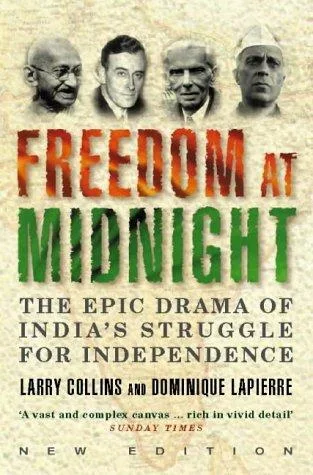
Freedom at Midnight (1997)
Freedom at Midnight is a 1997 politics and government book written by Dominique Lapierre and Larry Collins.
On the night of August 14, 1947, the British flag came down over New Delhi and a fifth of humanity claimed independence. Larry Collins and Dominique Lapierre reconstruct the year that led there and the one that followed, from Lord Mountbatten's arrival as the last viceroy to the funeral of Mahatma Gandhi. Drawing on interviews and archives, they weave the negotiations, the drawing of new borders, and the human cost of partition into a single narrative. It reads like reportage with the sweep of history, precise on detail and unflinching about the violence that freedom carried with it.
Similar books
Explore Freedom at Midnight guides
A few thoughts on Freedom at Midnight
Readers can follow the story onto the screen with Gandhi, Richard Attenborough's epic on the man whose funeral closes the book, and Viceroy's House, which stages the same partition from inside Mountbatten's residence. For the wider feel of history turning on a few rooms and decisions, Oppenheimer captures that same weight of consequence.
True stories of modern India, dramatized
Freedom at Midnight reconstructs the year India became independent through interviews and archives rather than invention. Gandhi dramatizes the same period through its central figure, Viceroy's House restages Mountbatten's final months overseeing the handover and the borders drawn in its wake, Dangal grounds a different decade of Indian life in one family's real achievement, and Made in India: A Titan Story traces an industrialist building something that outlasted him.
Real memoirs about freedom, displacement and history's hinge moments
Freedom at Midnight ends its account with the human cost of partition, the millions displaced by borders drawn almost overnight. Gandhi's own autobiography sits behind every page of that history as its central conscience, Frederick Douglass writes freedom from the inside as something fought for and won, Natan Sharansky's account of dissent and imprisonment carries the same hunger for liberty, and Refugee follows displacement as a lived, ongoing reality.