
From Tehran to the world
Marjane Satrapi grew up in Tehran during the Islamic Revolution and the Iran-Iraq War, and she drew what she remembered. Persepolis began as a French-language graphic novel published by L'Association in Paris: the first volume appeared in 2000, covering her childhood during the revolution; the second in 2001, following the war years. Two more volumes completed the memoir: Persepolis 3 (2002) traced her years as a teenager sent abroad to Vienna, and Persepolis 4 (2003) brought her back to Iran, through a difficult return, and finally out again to France for good.
The four books were collected into a single omnibus in French and in English translation by Pantheon Books under the title The Complete Persepolis. The stark black-and-white art, deliberately simplified in the tradition of Persian miniature painting, made the story immediately legible across languages and cultures. When the animated film arrived in 2007, it introduced Satrapi's childhood to millions who had never read a graphic novel, and the four-volume arc became one of the rare works that lives with equal force in both its original form and its adaptation.
Persepolis across time
- 2000Volume 1 published in French by L'Association Persepolis
- 2001Volume 2 published in French
- 2002Volume 3 published in French
- 2003Volume 4 published in French Persepolis
- 2004English translation of volumes 1 and 2 released by Pantheon Books
- 2005English translation of volumes 3 and 4 released by Pantheon Books
- 2007Complete omnibus published in French and English as The Complete Persepolis Persepolis
- 2007Animated film premieres at Cannes, wins the Jury Prize Persepolis
The definitive version: the animated film
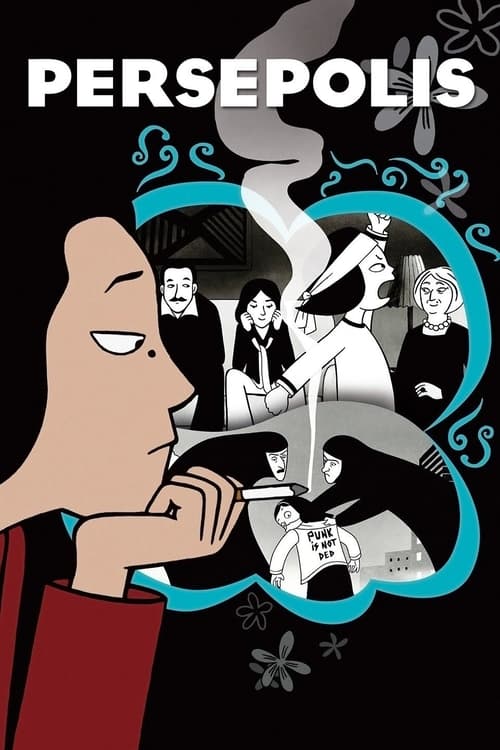
The 2007 film, co-directed by Satrapi and Vincent Paronnaud, is among the finest animated films ever made. It compresses the four volumes with almost no loss of emotional weight, renders the graphic novel's visual language in motion exactly as it should be, and features voice performances in the French original that are irreplaceable. Chiara Mastroianni as the adult Marjane and Catherine Deneuve as her mother are not just cast correctly: they are the film. Watching it before reading the books is the right order. The film opens the door; the books fill every room behind it.
Skip the English dub
The English dub of the animated film is serviceable, but the French voice cast is integral to the film's texture. The characters were written and performed in French first, and that language carries the specific register of a Parisian-Iranian childhood memory that English flattens. If you have the option, watch it in French with subtitles. The dub is not wrong; it is a lesser version of the same thing, and with this film lesser matters.
The overlooked depth: reading the four volumes separately
Most English-language readers only know The Complete Persepolis, the omnibus. Reading the four volumes as Satrapi originally published them, with the natural pause between each, changes the pacing entirely. Volume 3, covering Vienna, reads as almost a different book from the Tehran chapters, and that tonal break lands harder when it arrives as its own object rather than a chapter in a longer scroll. The omnibus is convenient; the original sequence is richer.

If you love Persepolis: graphic memoirs drawn from life
Personal history in ink, from conflict zones to displacement and illness


If you love Persepolis: coming of age when the world changes
Films about children and teenagers living through history they did not choose


If you love Persepolis: animation that refuses to be for children only
Animated films carrying adult memory, grief, and history