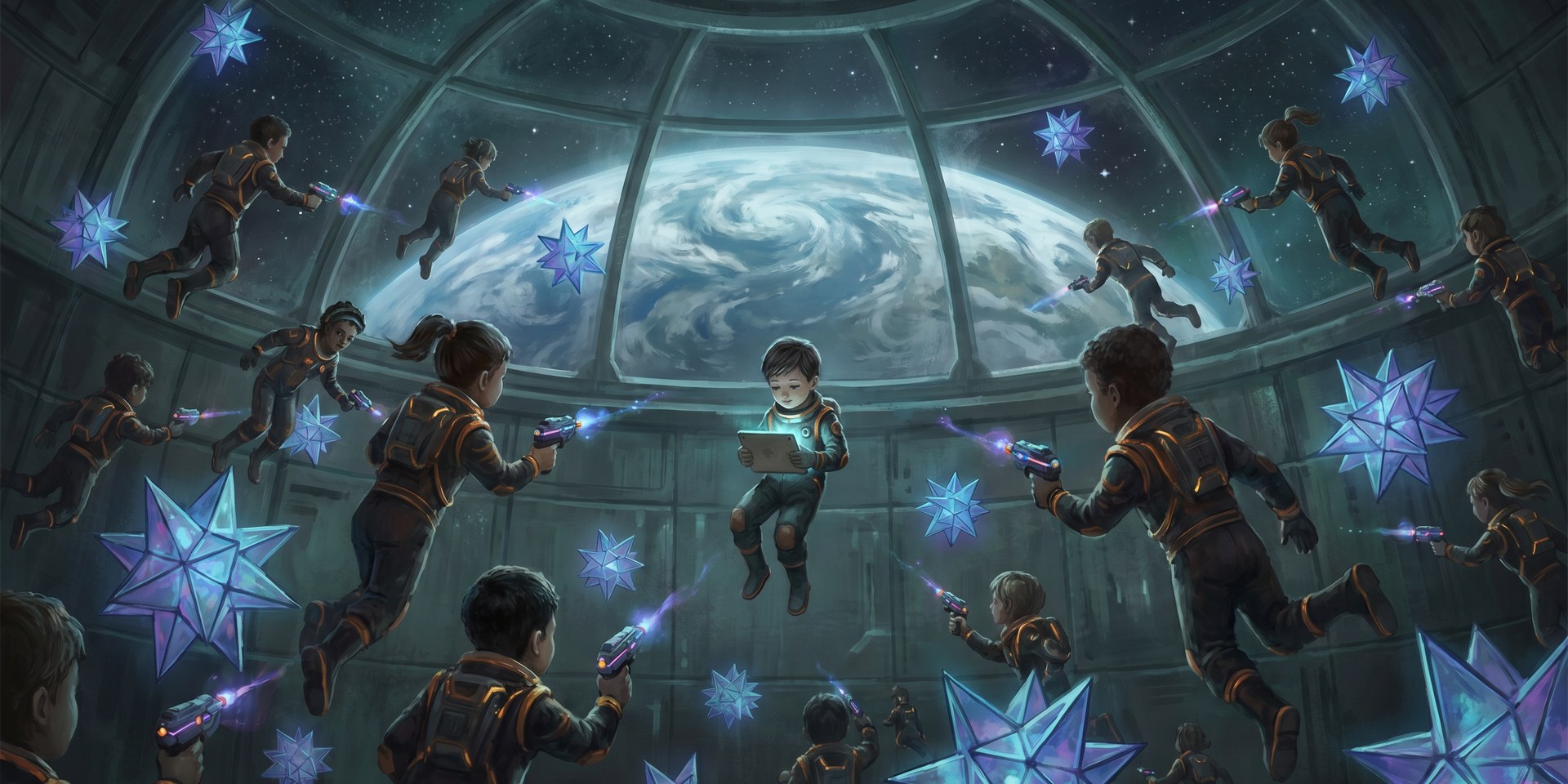

Andrew Wiggin is six years old when the International Fleet takes him from his family to Battle School, the orbital academy where humanity shapes its brightest children into the commanders of its war against an alien enemy. Orson Scott Card wrote that story in 1985, won the Hugo and Nebula, then did something almost no franchise author does: he followed the consequences instead of the formula.
The result is a universe with two spines. Ender's Saga leaves Earth behind and becomes contemplative, alien, three thousand years wide. The Shadow books stay home with Bean and turn into geopolitical thriller. Around them orbit the Formic War prequels and a shelf of standalones. This guide maps all of it, in the order that actually works.
Ender's Game and Speaker for the Dead are the strangest one-two punch in science fiction
The first book is a war story about children, all velocity and zero-gravity tactics. Its sequel jumps three thousand years, lands on a colony world, and becomes a slow, grave novel about xenobiology, guilt and how to mourn honestly. Both won the Hugo and Nebula, back to back, the first time any author had done that in consecutive years. Card has said Ender's Game existed partly so Speaker could exist. Read them as one long thought: the boy who won the war, and the man who spends forever answering for how.

Four decades of the Enderverse
- 1985Ender's Game expands the 1977 short story into the classic Ender's Game
- 1986Speaker for the Dead completes the double Hugo-Nebula Speaker for the Dead
- 1991Xenocide deepens the Lusitania crisis Xenocide
- 1996Children of the Mind closes Ender's own story Children of the Mind
- 1999Ender's Shadow retells Battle School through Bean Ender's Shadow
- 2001Shadow of the Hegemon brings the war home to Earth Shadow of the Hegemon
- 2005Shadow of the Giant crowns the Hegemon Shadow of the Giant
- 2008Ender in Exile bridges the gap between Game and Speaker Ender in Exile
- 2012Earth Unaware opens the First Formic War prequels Earth Unaware
- 2013The film brings Battle School to the screen Ender's Game
- 2016The Swarm opens the Second Formic War The Swarm
- 2017Children of the Fleet returns to Battle School Children of the Fleet
- 2021The Last Shadow finally merges both spines The Last Shadow
Two spines, one universe
The split happens in 1999. Ender's Shadow retells the first book from inside the head of Bean, the smallest kid in Battle School, and then refuses to follow Ender to the stars. While the Saga books drift further into philosophy, the Shadow series stays on an Earth suddenly full of unemployed child generals, and plays out as pure geopolitics: alliances, kidnappings, wars of succession. Same events, two completely different genres. It remains the cleanest trick in franchise fiction, and it means the Enderverse has an entry point for readers who want wonder and one for readers who want scheming.
Ender's Saga
In reading order: from Battle School to the edge of the galaxy


The Shadow series
Bean's story: the same war, played as a thriller




Ender's Shadow is the best reread trick ever pulled
Writing the same year of events twice should not work. Card makes it work by choosing the one character who saw everything Ender could not: Bean, the tiny survivor of the Rotterdam streets, who reverse-engineers Battle School's every manipulation while pretending to be ordinary. Scenes you thought you knew flip their meaning; the adults' cruelty becomes legible; Bean sees the machinery Ender never could. Read Ender's Game first, always. Then read this and watch the same story become a different book.
The Formic War prequels and returns
Prequels, novellas and returns


Card beyond the Enderverse
The other machines: colony ships, folk magic and fairy tales



In the moment when I truly understand my enemy, understand him well enough to defeat him, then in that very moment I also love him.Ender's Game
The man behind Battle School
Follow Orson Scott Card to his complete catalog across five series.
After Battle School: kindred stories
Child soldiers, impossible tests, and the war stories Ender's Game argues with


More universes to enlist in
Military Sci-Fi
Explore the Military Sci-Fi guide →Frequently asked
In what order should I read the Ender books?
Start with Ender's Game, no exceptions. Then choose your spine: Speaker for the Dead, Xenocide and Children of the Mind for the philosophical saga (with Ender in Exile as an optional bridge), or Ender's Shadow through The Last Shadow for the Bean line, which starts as Earthbound thriller and ends by rejoining Ender's story. The Formic War prequels read best after you know the universe, not before.
Is Ender's Shadow a sequel or a retelling?
Both, famously. It covers the same Battle School events as Ender's Game from Bean's point of view, then its own sequels (Shadow of the Hegemon onward) continue past the war on Earth while Ender's story leaves the planet entirely.
Did Ender's Game win awards?
Ender's Game and Speaker for the Dead won the Hugo and Nebula Awards for best novel in consecutive years, the first back-to-back double in the field's history. The 1985 novel grew out of Card's 1977 novelette of the same name.
Is the Ender's Game movie worth watching?
As a compressed highlight reel, yes: Asa Butterfield and Harrison Ford play it straight and the Battle Room looks right. But it folds years of Battle School into months, and the interior monologue that makes the book sting has nowhere to live on screen. Read first, then watch.
How does the Enderverse connect to Card's other series?
It does not, directly. The Homecoming Saga is his other science fiction epic, the Tales of Alvin Maker is his American folk-magic fantasy, and Pathfinder starts a separate time-bending trilogy. The connection is thematic: gifted children, moral weight, and communities learning to live with what survival cost.