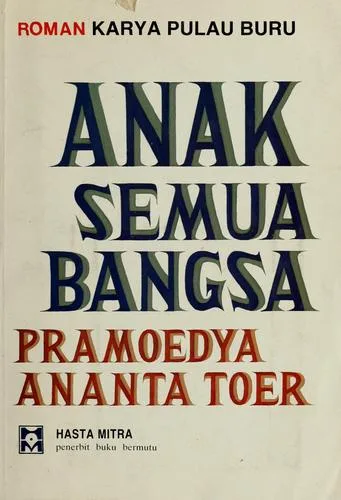
Anak Semua Bangsa (1996)
Anak Semua Bangsa is a 1996 fiction, general book written by Pramoedya Ananta Toer.
Minke, a Dutch-educated Javanese writer, comes of age in a colony that measures worth by birth and skin. The second novel of Pramoedya Ananta Toer's Buru Quartet follows him and his formidable mother-in-law Nyai Ontosoroh as the certainties of a European education give way to the injustice around them. Fluent in French, Dutch, Malay, and Javanese, Minke stands between two worlds and belongs fully to neither. Pramoedya composed the quartet as a prisoner on Buru Island, first telling it aloud to fellow inmates. The result is a searching portrait of a mind waking to its own people.
Similar books
Explore Anak Semua Bangsa guides
A few thoughts on Anak Semua Bangsa
Minke's slow political awakening under Dutch rule finds a cinematic echo in Peter Weir's The Year of Living Dangerously, where a foreign journalist confronts the fault lines of Indonesian power decades later. Both hold a single conscience up against a system that sorts people by birth and origin.
Fiction and history about growing up caught between two worlds under empire
Minke grows up straddling a European education and the Javanese world that education was built to erase. The Year of Living Dangerously returns to a later, equally fractured Java, Frederick Douglass turned literacy into a weapon against a system meant to keep him powerless, Assassin's Creed III follows a mixed-heritage hero pulled between two peoples, and Dangal shows discipline breaking open a world built to exclude someone.
Games that turn real historical empires into an explorable stage
Anak Semua Bangsa rebuilds colonial Java from testimony and memory rather than conquest. These games take the more kinetic route into real empires: Assassin's Creed II and Brotherhood move through Renaissance Italy's power struggles, Black Flag sails the Caribbean's colonial trade routes, and Uncharted's Drake digs through the ruins real empires left behind.
TV epics set in the middle of one people's rule over another
Minke's Java sits under a rule that decides who counts as fully human, and these shows return to similar fault lines. Vikings follows a world being remade by conquest, Spartacus: House of Ashur puts a rebellion against Rome's slave system at its center, The Last Kingdom follows a man caught between Saxon and Dane, and Archives: The Nanyang Mystery digs into the region's own layered colonial past.