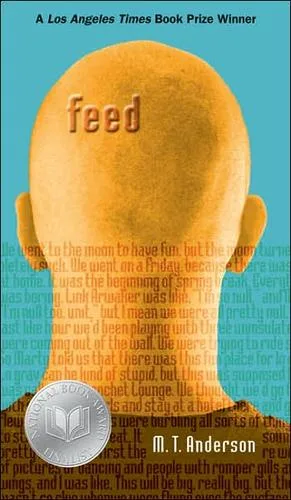
Feed (2002)
Feed is a 2002 science fiction book written by M. T. Anderson.
Titus lives inside the feed, a networked implant wired into his brain since birth, streaming ads, chat, and shopping straight into his thoughts. On a dull trip to the moon he meets Violet, who wants to resist the feed and reclaim her own mind. M. T. Anderson writes their romance in the corroded slang of teenagers who have never known silence, a voice that is funny, then hollow. Around them the American landscape sickens and the corporations keep selling. The satire runs close to the present, tracking how attention gets bought and how longing gets turned into a market.
Similar books
Explore Feed guides
Feed in our writing
- Companion guide: Near-Future Speculation
- Companion guide: YA Dystopias: The Hunger Games and the Decade the Arena Ruled
- Companion guide: YA Science Fiction: Starships, Cyborgs and the Kids Who Outthink the Adults
A few thoughts on Feed
Ghost in the Shell pushes the same wired-brain unease toward its philosophical edge, asking who owns a networked mind. BioShock turns a consumer paradise into a trap built on a rotten ideal. For the sound of a corporate future, Deltron 3030 raps from inside a decayed year 3030, and The Matrix pictures a mind sold a comfortable lie.
Minds wired into a system that never lets go
Titus's feed streams ads and chatter straight into his skull from birth, so stepping outside it means stepping outside reality. BioShock's Rapture and The Matrix's simulated world both trap people inside systems built to look like free choice, Black Mirror keeps testing that same premise episode after episode, and Ghost in the Shell and Portal 2 ask what is left of a person once a machine does the thinking.
Ads and broadcasts running the whole rotten show
Anderson writes Feed as a satire where corporations own attention itself, buying and shaping it before anyone notices. The Boys turns that same instinct toward superhero marketing, Repo! The Genetic Opera stages it as biotech opera, BioShock Infinite dresses it up as patriotic spectacle, and The Dark Knight Returns and 20th Century Boys both trace how broadcast media can steer an entire society.
Futures that look fine until you see the cracks
Feed's America keeps shopping and streaming even as the landscape sickens around it, a rot nobody wants to name. Thunderhead and The Scorch Trials watch young people wake up to that same denial, Silo builds a whole society on a lie everyone has agreed not to question, and Half-Life 2 and Galaxy Express 999 both show worlds where control has simply become the furniture.
Concept albums for a world plugged into the feed
Feed's satire runs on the corroded slang of teenagers raised inside a nonstop broadcast, and these four albums share that same unease with being plugged in. Muse's Simulation Theory and Black Holes and Revelations both worry over surveillance and control, Deltron 3030 imagines a corporate future through a rapping mech pilot, and Ayreon's Universal Migrator closes out a saga of humanity swallowed by bigger systems.