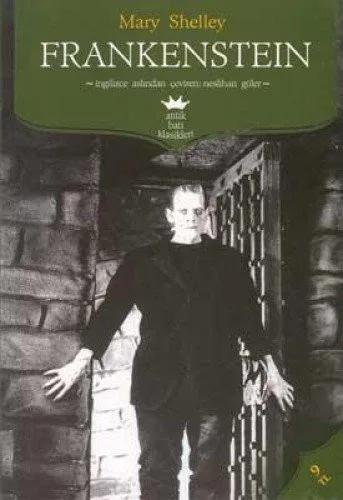
Frankenstein or The Modern Prometheus (2006)
Frankenstein or The Modern Prometheus is a 2006 frankenstein (fictitious character) book written by Mary Shelley.
Victor Frankenstein flees the room the instant his creature draws breath. That is the engine of the whole novel. A young Genevan student obsessed with the boundary between living and inert matter assembles a thinking being out of body parts, succeeds, and then cannot bear to look at what he has made.
Mary Shelley builds the book as a set of nested accounts: an Arctic explorer writing home, with Victor's confession inside his letters and the creature's own testimony inside that. The horror reaches the reader at second and third hand, filtered through ice and hindsight, and the arrangement means nobody's version can be fully trusted. The creature is the most articulate voice in the book. He reads, he reasons, he asks for the one thing his maker owes him, and Shelley never lets Victor off the hook for the answer.
She started writing at eighteen and the first edition appeared anonymously in London on 1 January 1818, when she was twenty. It works simultaneously as Gothic terror, as one of the founding arguments for science fiction as a serious form, and as a question about responsibility that has aged in the opposite direction from most novels of its year. It gets sharper every decade.
Explore Frankenstein or The Modern Prometheus guides
Frankenstein or The Modern Prometheus in our writing
- Companion guide: Body Horror
- Companion guide: Dark Academia
- Companion guide: Genetic Engineering & Designer Humans
- Companion guide: Mad Scientists
A few thoughts on Frankenstein or The Modern Prometheus
The screen has been rewriting this book for a century and the versions disagree with each other, which is what makes them worth lining up. Frankenstein is the earliest attempt anyone made, a silent short out of Edison's studio. The Curse of Frankenstein puts the cruelty back where Shelley aimed it, on the maker rather than the made. Mary Shelley's Frankenstein restores the Arctic frame and gives the creature his argument back. Mary Shelley sets the monster aside for the eighteen-year-old who invented him.
And if the nerve here is a maker who disowns what he makes, The Darwin Incident moves that into a modern lab, where a being nobody planned for has to argue for its own personhood.
Created beings that come to life and turn on their makers
Frankenstein assembles a living creature from dead tissue and flees the moment it draws breath. These picks share that setup: a maker builds a new being, then reckons with what they owe the thing they made. From wooden boys who wake up to engineered artificial minds, each follows a creation that refuses to stay an object.
Ordinary people turned into monsters by science
Victor Frankenstein's experiment produces a being the world reads as a monster on sight. These stories run the same current through a human body: a lab accident, an injection, or an outbreak that rewrites a person into something feared and hunted. The science is the trigger, and the horror is what it makes of flesh.