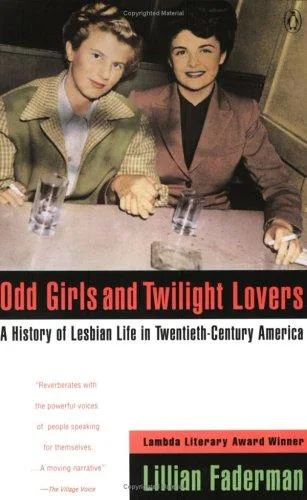
Odd Girls and Twilight Lovers (1991)
Odd Girls and Twilight Lovers is a 1991 history book written by Lillian Faderman.
Lillian Faderman traces lesbian life across twentieth-century America, from the romantic friendships of the century's start through bar culture, wartime upheaval, medical pathologizing, and the political awakenings that followed. She works from diaries, unpublished manuscripts, pulp novels, songs, medical literature, and firsthand testimony gathered across race, class, and generation. The result is a social history of how identity and community formed and re-formed under shifting pressure. Winner of the Stonewall Book Award, it reads as both scholarship and recovery, insisting that lives long undocumented or dismissed have a history worth telling in full, and worth telling with care.
Similar books
Explore Odd Girls and Twilight Lovers guides
A few thoughts on Odd Girls and Twilight Lovers
Lillian Faderman's history gives the backdrop to a lot of screen work that dramatizes it. Carol captures the coded caution of mid-century romance, Paris Is Burning documents the ballroom communities she traces toward the century's end, and Tales of the City follows a chosen family across the same decades. Each puts faces and voices to the lives her archive works to recover.
Queer lives and loves that history tried to erase
Lillian Faderman rebuilds a century of lesbian life from diaries, pulp novels and testimony that official history left out. Tales of the City gathers a queer family in San Francisco, Carol follows a forbidden 1950s romance, Paris Is Burning documents ballroom culture built by queer people of color, The Song of Achilles finds hidden love in ancient Greece, and Just Kids traces a queer bohemian friendship in New York.
American history rebuilt from the testimony official records left out
Faderman works from diaries and testimony official records ignored, and these follow the same method with different subjects. Frederick Douglass's own narrative recovers a life American law tried to erase, American Experience documents the same overlooked corners of the national story, Call the Midwife reconstructs working-class women's lives through the people who lived them, and Maus rebuilds a family's Holocaust survival from firsthand memory instead of official history.