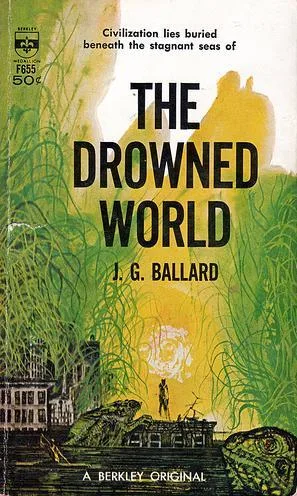
The Drowned World (1962)
The Drowned World is a 1962 english fiction book written by J. G. Ballard.
Solar radiation has boiled off the ice caps and dragged Earth back into a steaming Triassic age. London survives as a chain of silt lagoons, tropical vines climbing the Ritz, giant reptiles gliding past the drowned offices. A team of scientists maps the ruin while salvage crews drain the streets for treasure. Biologist Robert Kerans, quartered in a suite atop a submerged hotel, feels the heat slowly rewiring his mind. Ballard writes the catastrophe as a lush, hallucinatory homecoming rather than a disaster, tracking the pull of the ancient sun on human instinct. Slow, feverish, unmistakably his own.
Similar books
Explore The Drowned World guides
The Drowned World in our writing
- Companion guide: Climate Fiction
- Companion guide: Disaster
- Companion guide: Killer Plants & Botanical Horror
A few thoughts on The Drowned World
For the same drowned grandeur, try BioShock, where a sunken art-deco city rots beautifully around you and its founder's dream curdles into a trap. J. G. Ballard's slow psychological drift also rhymes with Tarkovsky's Stalker, a film that treats a ruined zone as a mirror for the mind rather than a threat to escape.
Post-catastrophe worlds turned into something stranger than ruins
The Drowned World turns a flooded, reptile-choked London into a hallucinatory homecoming rather than a disaster, catastrophe rendered strange and dreamlike instead of merely grim. BioShock does something similar underwater, a flooded utopia gone to rot beneath the ocean, Stalker turns its ruined zone into an eerie, half-sacred landscape, and Silo seals its survivors inside a single structure that has replaced the whole world.
Concept albums that imagine a dying or distant future world
The Drowned World imagines Earth's future as a slow, feverish reversion rather than an explosion, and a handful of concept albums chase that same widescreen science-fiction dread. Black Holes and Revelations and Simulation Theory both build entire records around dystopian futures, Deltron 3030 raps through a collapsed future society, and Universal Migrator imagines an alien and human history colliding across time.
Small teams of scientists trying to make sense of a world that's turned against them
The Drowned World follows a small team of scientists mapping a ruined, superheated London, more curious than frightened of the wreck. Project Hail Mary strands its own lone scientist somewhere just as hostile and asks him to understand it before it kills him, Interstellar sends its crew hunting for a survivable world once Earth stops cooperating, and War of the Worlds forces ordinary people to reckon with an environment gone hostile overnight.
Comics that picture civilization well past its peak
The Drowned World pictures London centuries after its fall, submerged and half-reclaimed by prehistoric heat and vegetation. The Dark Knight Returns imagines an aging hero returning to a city that has visibly decayed around him, 20th Century Boys spins a conspiracy out of a civilization sliding toward collapse, and Phoenix tracks the rise and fall of whole civilizations across vast stretches of time.