

The novel that invented the pleasure cage
Aldous Huxley published Brave New World in 1932, and it landed like a prophecy wearing a satirist's mask. The story: a World State has eliminated suffering by engineering humans into castes, flooding them with a happiness drug called soma, and erasing history, art, and family. Bernard Marx and Lenina Crowne visit a Savage Reservation and bring back John, a man raised on Shakespeare who has never been conditioned. John's collision with the World State is the book's real engine, and it ends badly for him.
Huxley was writing in response to H.G. Wells's optimistic techno-utopias and to the early Soviet state. He set the story in AF 632 (After Ford, as in Henry Ford) and built a world that felt like a reductio ad absurdum of consumer capitalism and behaviorist psychology. The novel has never gone out of print, and it keeps attracting adaptors because its central question stays fresh: if you could be engineered to be contented, would that be freedom or its precise opposite?
The story has crossed into radio, film, and television three times in the past ninety years, with each adaptation reflecting the anxieties of its own era.
Every version of Brave New World
The source novel and every major adaptation across media


Brave New World across the decades
- 1932Aldous Huxley publishes the novel Brave New World
- 1956CBS Radio Workshop two-part adaptation, narrated by Huxley himself, with a score by Bernard Herrmann
- 1958Huxley publishes his own reassessment of the novel's predictions Brave New World Revisited
- 1980NBC television film starring Keir Dullea and Bud Cort Brave New World
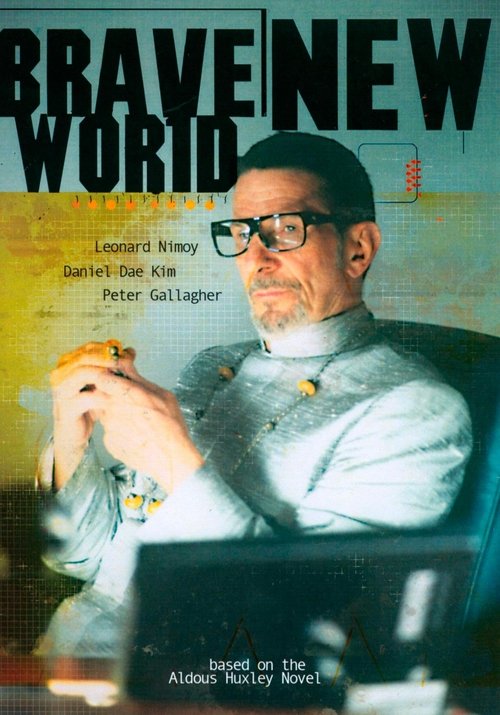
- 1998NBC television film starring Peter Gallagher as Bernard Marx and Leonard Nimoy as Mustapha Mond Brave New World
- 2020Peacock prestige drama series starring Alden Ehrenreich as John the Savage and Nina Sosanya as Mustapha Mond Brave New World
The 1998 NBC film is the definitive screen version
The 1998 NBC television film, written by Todd Alcott and directed by Leslie Libman and Larry Williams, gets more right than it has any right to given its budget. Leonard Nimoy is perfectly cast as Mustapha Mond: cold, reasonable, and genuinely tragic. Peter Gallagher plays Bernard as the right kind of inadequate. The film respects the novel's bleak ending and does not flinch from Huxley's point that the World State is appealing precisely because it works. It is not great television by modern standards, but it is the most faithful and tonally accurate adaptation the novel has received.
The 2020 Peacock series is worth more credit than it got
The Peacock series (2020) was cancelled after one season. Critics were mixed and audiences did not find it. That is a shame, because the production design is extraordinary and the decision to reimagine the caste system through a social-media lens (Alphas as influencers, soma as algorithmically optimised mood management) is genuinely smart rather than just cosmetic. Nina Sosanya as Mustapha Mond and Harry Lloyd as Bernard Marx are the best things in it. The show's problem is that it softens John the Savage into a conventional protagonist, which is the one choice Huxley would have objected to most.
The 1980 NBC film: watch it for curiosity only
The 1980 NBC television film directed by Burt Brinckerhoff stars Keir Dullea and Bud Cort, and it is unmistakably a product of its budget and its network. The World State looks like a shopping mall. The adaptation defangs the satire and adds a romantic resolution that Huxley would have found inexplicable. It is not offensively bad, but it demonstrates precisely why the material is hard to adapt: a comfortable Hollywood happy-ish ending is the opposite of what the novel is arguing for.
If you love the engineered society
Other stories about pleasure-states, caste systems, and the cost of contentment






If you love the outsider who refuses to be happy
Stories about individuals who reject what everyone else accepts






Engineered Societies and Classic Dystopias
Every Version of Nineteen Eighty-Four
Explore the Every Version of Nineteen Eighty-Four guide →One believes things because one has been conditioned to believe them.Aldous Huxley, Brave New World (1932)