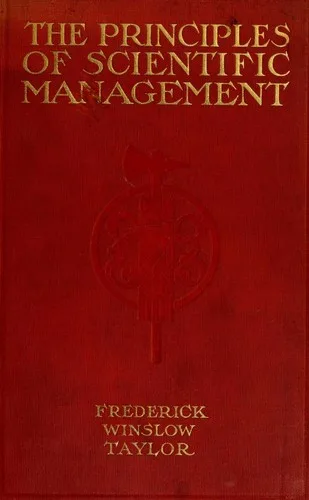
The Principles of Scientific Management (1911)
The Principles of Scientific Management is a 1911 industrial management book written by Frederick Winslow Taylor.
Frederick Winslow Taylor spent his career with a stopwatch, timing men as they shoveled pig iron and loaded rail cars. This 1911 monograph gathers what he concluded: that most labor runs on habit and guesswork, and that management could measure each task, break it into steps, and fix a single best method for the work. Taylor argues for training, standard tools, and wages tied to output, against the old idea that a workman should decide how to do his own job. It reads as a blunt founding document of industrial efficiency, and of everything later critics would call Taylorism.
Similar books
Explore The Principles of Scientific Management guides
A few thoughts on The Principles of Scientific Management
Charlie Chaplin turned this worldview into comedy in Modern Times, where the assembly line swallows the worker whole. For a version you run yourself, the factory-automation game Factorio makes Taylor's logic playable: measure, optimize, and never let a belt sit idle. Both catch the promise and the cost of treating human work as a solvable equation.
Efficiency systems that treat workers as parts of a machine
Taylor wrote this book to turn a workman's judgment into a stopwatch and one correct method. Factorio makes a game out of timing every task on a line, Modern Times turns Chaplin into the punchline of an assembly line built for speed, The Wealth of Nations lays out the division of labor Taylor later scaled up, and No Logo tracks what that efficiency costs the workers behind it.
Nonfiction that questions who benefits once everything gets measured and managed
Taylor's stopwatch reduced labor to a measurable output, and this set keeps asking who that measurement really serves. How to Lie with Statistics shows how easily numbers bend to fit an argument, Debt argues a ledger hides the human relationship underneath it, Eichmann in Jerusalem watches a bureaucrat hide behind correct procedure, and Manufacturing Consent traces how a system engineers compliance while calling it neutral.