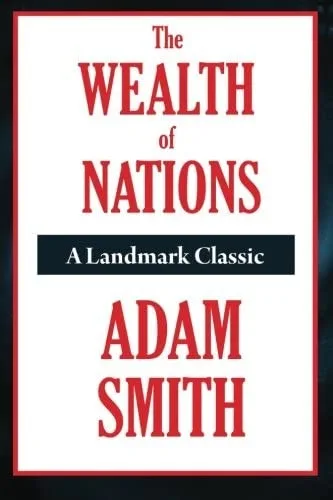
The Wealth of Nations (1776)
The Wealth of Nations is a 1776 economische filosofie book written by Adam Smith.
Adam Smith set out in 1776 to answer a plain question: what actually makes a nation rich. His answer runs through workshops and ports rather than royal treasuries. He opens with the pin factory, showing how splitting one job into many steps multiplies output, then builds outward to explain how the division of labour, prices, and self-interested trade coordinate strangers with no central plan. Smith writes as a moral philosopher watching the early Industrial Revolution, arguing for free markets while noting where merchants and monopolies bend them. Dense, digressive, and quotable, it remains the founding text that later economics keeps arguing with.
Explore The Wealth of Nations guides
A few thoughts on The Wealth of Nations
Follow it with the debates it started: read it against later critiques of capitalism and industrial labour, or alongside popular economics that stress-tests Adam Smith's assumptions with modern data. Documentaries on globalization and the history of trade make good companions, tracing the pin factory logic straight into container ships and supply chains.
Foundational books on how economies actually work
Adam Smith opens with a pin factory to show how splitting one job into many steps multiplies output, then explains how prices and self-interest coordinate strangers with no central plan. These books keep asking the same plain question about wealth, labor, and value, tracing where it comes from and who ends up holding it across centuries of changing markets.
Sharp critiques of markets and the people who bend them
Smith argued for free trade but watched merchants and monopolies twist it toward their own gain. These books pick up that suspicious eye and turn it on modern capitalism, following the brands, shocks, and quiet arrangements that let a market serve the few while claiming to serve everyone.
Classic works of political and moral philosophy
The Wealth of Nations reads as a moral philosopher watching the early Industrial Revolution and arguing about how people should live together. These older classics sit beside it on the shelf: dense, quotable arguments about power, education, toleration, and justice, each trying to reason out the rules a decent society runs on.
Big-idea books that rethink how society should be organized
Smith described an economy that coordinates itself through countless small trades rather than a royal plan. These books take the opposite risk and sketch whole systems on purpose: fairer distributions, guaranteed floors, and other blueprints for arranging work and wealth, each convinced the current setup is a choice we could remake.